
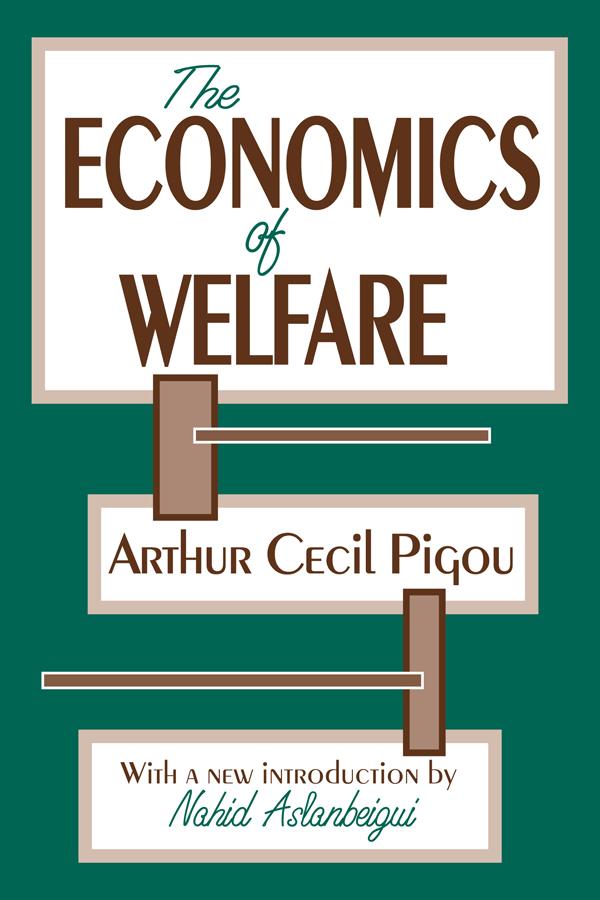
The Economics of Welfare occupies a privileged position in economics. It contributed to the professionalization of economics, a goal aggressively and effectively pursued by Pigou's predecessor and teacher Alfred Marshall. The Economics of Welfare also may be credited with establishing welfare economics, by systematically analyzing market departures and their potential remedies. In writing The Economics of Welfare, Pigou built a bridge between the old and the new economics at Cambridge and in Britain. Much of the book remains relevant for contemporary economics. The list of his analyses that continues to play an important role in economics is impressive. Some of the more important include: public goods and externalities, welfare criteria, index number problems, price discrimination, the theory of the firm, the structure of relief programs for the poor, and public finance. Pigou's discussion of the institutional structure governing labor-market operations in his Wealth and Welfare prompted Schumpeter to call the work "the greatest venture in labor economics ever undertaken by a man who was primarily a theorist."
The Economics of Welfare established welfare economics as a field of study. The first part analyzes the relationship between the national dividend and economic and total welfare. Parts II and III link the size of the dividend to the allocation of resources in the economy and the institutional structure governing labor-market operations. Part IV explores the relationship between the national dividend and its distribution.
In her new introduction, Nahid Aslanbeigui discusses the life of Pigou and the history of The Economics of Welfare. She also discusses Pigou's theories as expressed in this volume and some of the criticisms those theories have met as well as the impact of those criticisms. The Economics of Welfare is a classic that repays careful study.
Pay easily by card, Klarna, Apple Pay or Google Pay. Not happy? You always have a 14-day money-back guarantee. Read more in our terms. If you have any questions, email us at hello@memmo.org.
Memmo makes studying easier – wherever you are in the world. We bring your course books and smart study tools together in one place: summaries, quizzes, podcasts and flashcards. Plus Ted, your study buddy who answers anything you wonder. Over 50,000 students already study here – built to help you learn faster and stress less.