
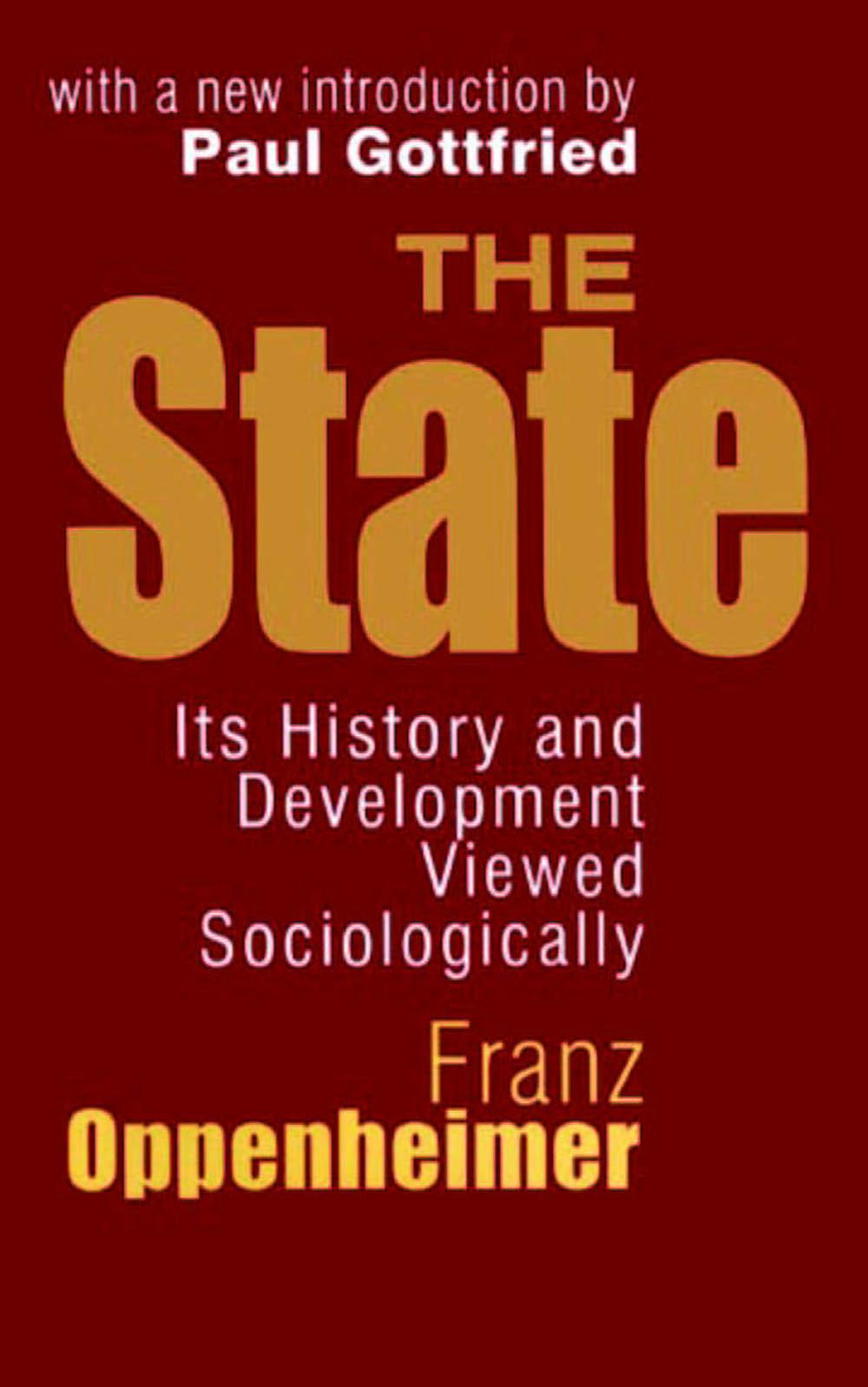
The State represents the epitome of Franz Oppenheimer's thinking. It integrates political and historical philosophy on the one hand, with economic philosophy on the other. Oppenheimer believed the future progress of nations would be in the direction of liberal socialism. He foresaw a society free from all monopolistic tendencies through unfettered competition.
According to Oppenheimer, competition is restrained by a powerful class monopoly, created not through economic differentiation, but through political power. This class monopoly stands between the masses and the land. The laboring class is subject to the will of the upper classes because it does not control the means of production necessary to work in its own interest. Oppenheimer asserts that the right to hold more land than one can properly work through his own efforts and the efforts of his family cannot exist without political control, and is the single most important explanation for the formation of monopolies in human society. He proves his theory in an original analysis.
Paul Gottfried writes in the new introduction that The State sums up and illustrates Oppenheimer's general theory of the origin, development, and expected transformation of the state, central political institution of the modern world. Much of Oppenheimer's work embodies the same independent spirit reflected in his way of life. The State provides a wealth of information for economists, political theorists, and sociologists.
Franz Oppenheimer was professor of economics and sociology at the University of Frankfurt in Germany until he retired in 1929. In 1933 he was forced to flee the Nazi regime and eventually came to the United States, where he died in 1943.
Paul Gottfried is professor of political science at Elizabethtown College in Pennsylvania. He is the author of The Search for Historical Meaning; Carl Schmitt: Politics and Theory; Conservative Millenarians: The Romantic Experience in Bavaria; and After Liberalism (forthcoming from Princeton University Press). He is general editor of Religion and Public Life.
Pay easily by card, Klarna, Apple Pay or Google Pay. Not happy? You always have a 14-day money-back guarantee. Read more in our terms. If you have any questions, email us at hello@memmo.org.
Memmo makes studying easier – wherever you are in the world. We bring your course books and smart study tools together in one place: summaries, quizzes, podcasts and flashcards. Plus Ted, your study buddy who answers anything you wonder. Over 50,000 students already study here – built to help you learn faster and stress less.