
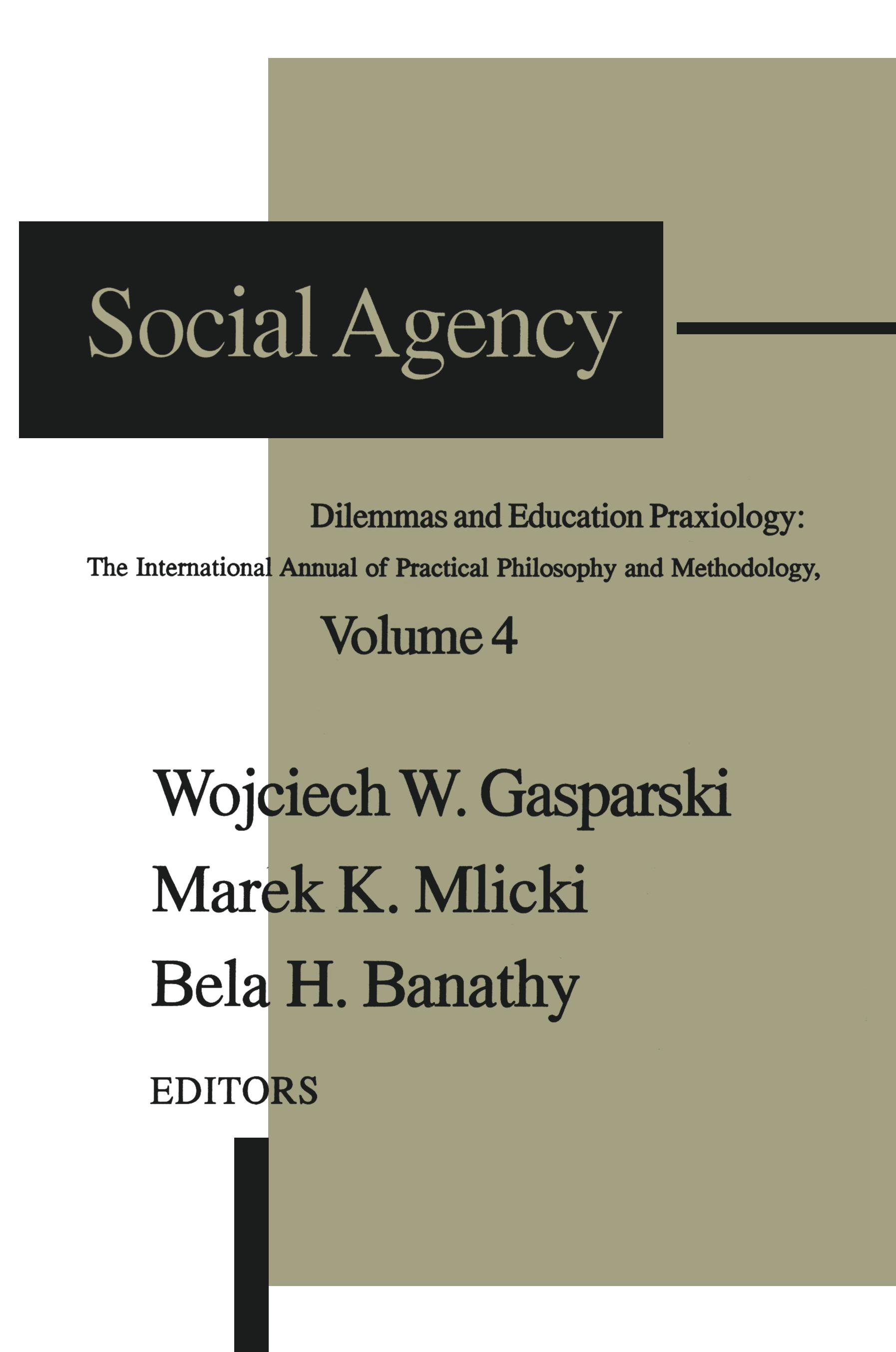
Praxiology deals with doing and working from the point of view of effectiveness. It has three components: analysis of concepts involving purposive actions; critique of models of action from the viewpoint of efficiency; and normative advisory aspects in recommendations for increasing human efficiency. This fourth volume of the Praxiology series is devoted to the very special topic of social agency. It focuses on two important praxiological concepts: rationality and preparation as preconditions for human action to be effective and efficient.
The question of efficiency was raised by Anatol Rapoport over three decades ago in his lecture to the audience at the Praxiological Seminar in Warsaw in 1961. Social Agency begins with an article written by this same famous scholar on the topic of decision theory, "Social Dilemmas: A Historical Overview." Social dilemmas is the subject of the first part of this volume, a question related to studies on human action guided by two types of rationality: individual and collective rationality. The intersection of the two, in which individuals meet collectives, creates the situation in which social agency emerges, generating dilemmatic circumstances for the actors involved.
The articles collected in the second part explore praxiological dimensions of education aimed toward the knowledge society, because of knowledge possessed and produced by educated persons. Chapters and contributors to volume 4 include: "Five Questions on the Research on Social Dilemmas" by Marek K. Mlicki; "Psychological Processes Underlying Cooperation in Social Dilemmas" by Paul A. M. Van Lange and David M. Messick; "Designing a System for Design Learning: Designers and/or Learners?" by Arne Collen; "Creating an Evolutionary Image of New Systems of Learning and Human Development" by Janet A. Khan; and "A Study Program Design in Retrospect" by Stig C. Holmberg. Social Agency continues the trend of original research done in a little-known, but important area. Social scientists, policymakers, and educators will benefit from this work.
Pay easily by card, Klarna, Apple Pay or Google Pay. Not happy? You always have a 14-day money-back guarantee. Read more in our terms. If you have any questions, email us at hello@memmo.org.
Memmo makes studying easier – wherever you are in the world. We bring your course books and smart study tools together in one place: summaries, quizzes, podcasts and flashcards. Plus Ted, your study buddy who answers anything you wonder. Over 50,000 students already study here – built to help you learn faster and stress less.