
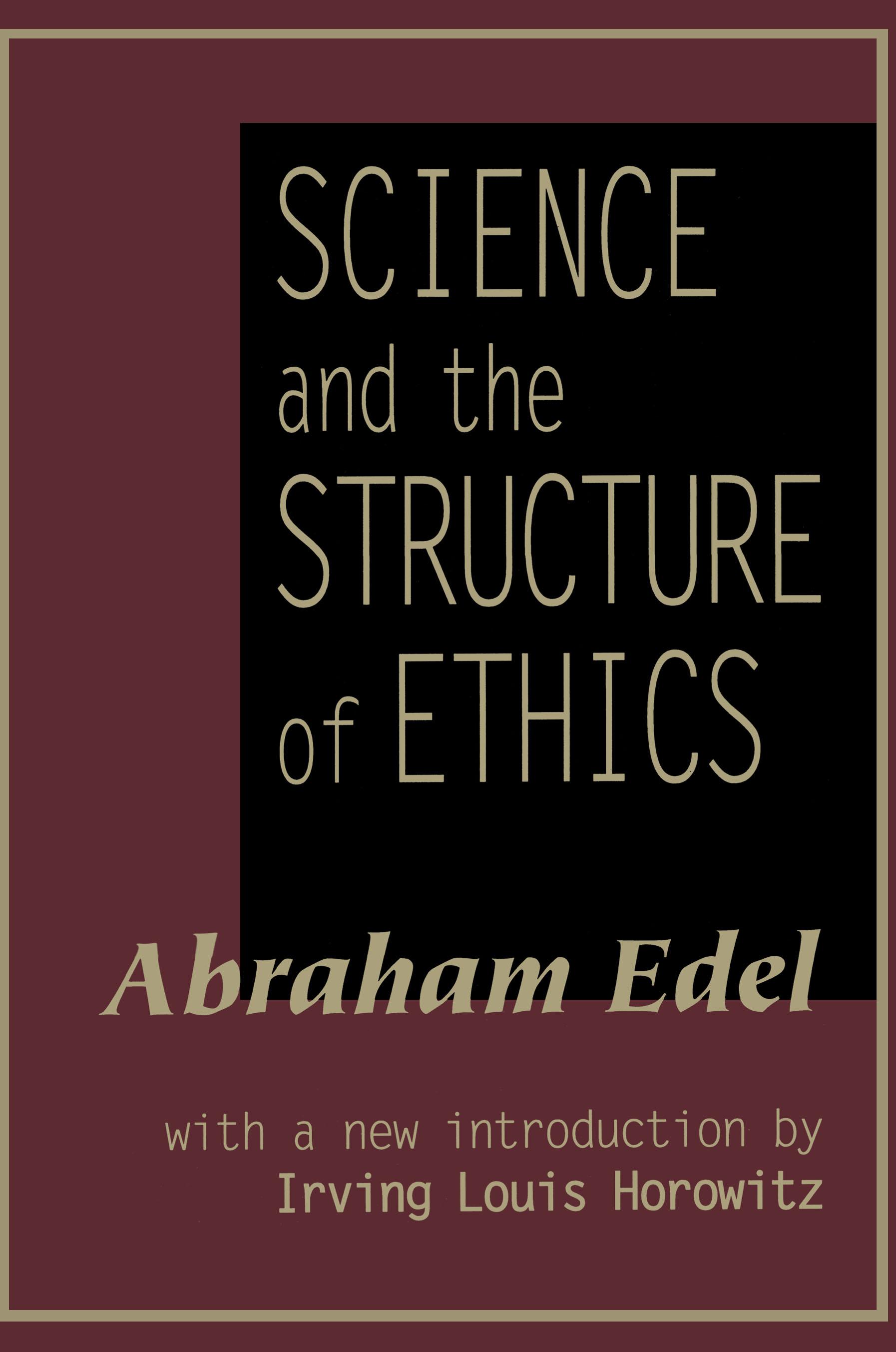
Initially prepared as part of the Foundations of the Unity of Science volumes under the auspices of the International Encyclopedia of Unified Science, Science and the Structure of Ethics soon took on a life of its own. Well positioned in the naturalistic tradition of ethical theory extending from John Dewey at the start and Richard Rorty at the conclusion of the century, Abraham Edel's volume offers a remarkable synthesis of the ways hi which ethical statements can be examined, and the nature of ethical concerns.
Edel reveals a singular capacity to move beyond oracular controversies of the good and the right hi favor of a comparative, analytic, and functional account of how ethical perspectives and practices affect the content of moral discourse. In Edel's work, the structure of ethical behavior is defined by biological, psychological, social, and historical functions. Hence a scientific account of ethics is possible since moral norms are themselves products of an experiential field open to verification procedures common to all other walks of human life.
In reviewing the impact of Edel's work hi general, and this volume in particular, Irving Louis Horowitz notes that Edel's naturalistic emphasis fits neatly with a view of ethics as something grounded in human experience rather than mandated from divine assumption: "It is hard for me to imagine a turning back from the hard lessons of the century, any more in ethical theory than in empirical research as such. We owe a central place in our century's intellectual capital to Edel's examination of ethical doctrines in the light of changing circumstances." This is a work certain to enlist the interest of ethicists, sociologists of knowledge, as well as those concerned with issues hi the philosophy of science and religion alike.
Pay easily by card, Klarna, Apple Pay or Google Pay. Not happy? You always have a 14-day money-back guarantee. Read more in our terms. If you have any questions, email us at hello@memmo.org.
Memmo makes studying easier – wherever you are in the world. We bring your course books and smart study tools together in one place: summaries, quizzes, podcasts and flashcards. Plus Ted, your study buddy who answers anything you wonder. Over 50,000 students already study here – built to help you learn faster and stress less.