
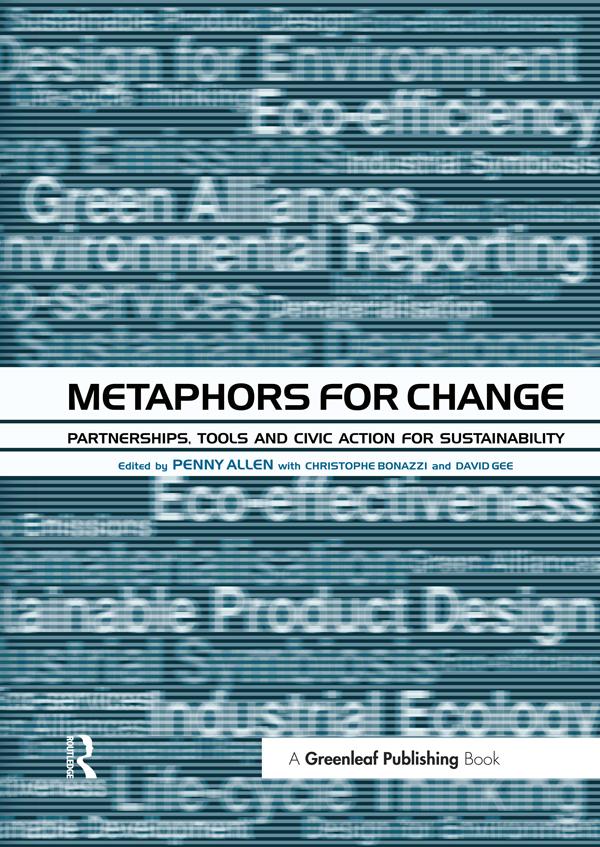
How can we get from where we are to where we want to be? Metaphors for Change attempts to answer this question and provide a roadmap for sustainability by bringing together the thoughts of a unique collection of leading change agents from business, government and academia.
Environmental questions have previously been dealt with metaphorically, by catastrophism or manicheism (zero growth; Malthusianism, Deep Ecology; "man is the enemy"; less is more). These metaphors have had limited impact because they have failed to connect with the mainstream of cultural, political, and business ideas. This book examines a number of new metaphors – and related partnerships, tools and action – which appear to have greater possibilities for the world in which we now live.
The editors argue that Metaphors for Change can deliver to the public and to decision-makers new perceptions ("structured knowledge") that can help interpret the past and the present, and help us forge the future. The wider the gap between the "now" and the "necessary", the stronger the bridging perceptions have to be in order to break through barriers of fear and conservatism. Some of the concepts considered are: sustainable development; the polluter pays principle; the precautionary principle; eco-efficiency; eco-effectiveness; life-cycle assessment; design for the environment; eco-services; dematerialization; industrial symbiosis; industrial ecology; and zero emissions. There are of course other useful metaphors on the horizon, some of them included in this book.
Including key contributions from the ground-breaking conferences ECO 97 and ECO 99, along with other specially commissioned and reprinted pieces, Metaphors for Change provides a treasure chest of new ideas, innovations and action. Accessible and forward-thinking, it will prove indispensable both as a student learning tool and as a panoramic overview of the sustainability metaphors key thinkers believe we should be putting into practice.
Pay easily by card, Klarna, Apple Pay or Google Pay. Not happy? You always have a 14-day money-back guarantee. Read more in our terms. If you have any questions, email us at hello@memmo.org.
Memmo makes studying easier – wherever you are in the world. We bring your course books and smart study tools together in one place: summaries, quizzes, podcasts and flashcards. Plus Ted, your study buddy who answers anything you wonder. Over 50,000 students already study here – built to help you learn faster and stress less.