
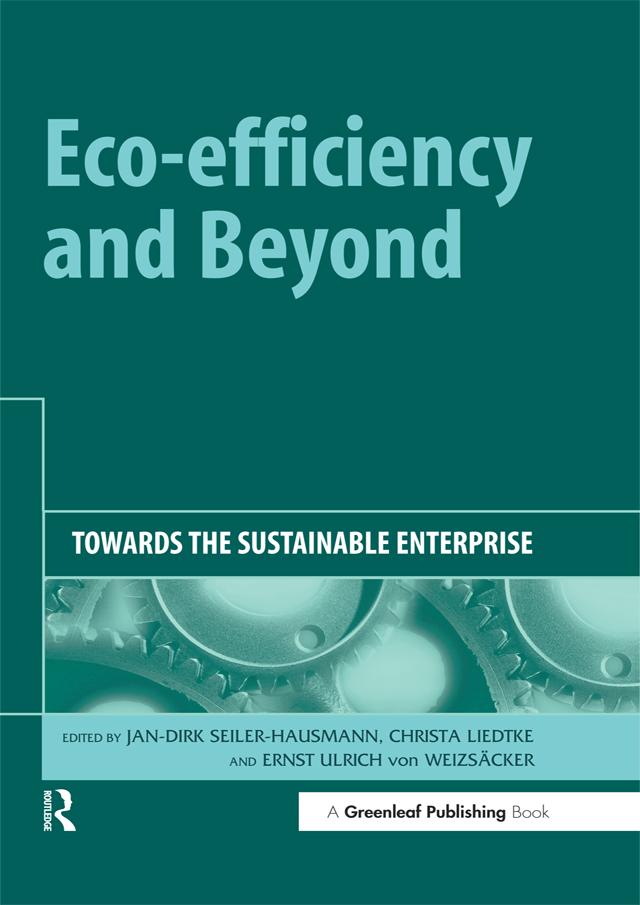
Business-as-usual, it is widely accepted, will exceed the Earth's carrying capacity in an alarmingly short space of time. In simple terms, we need to learn to use the world's rapidly depleting resources in a significantly more efficient manner. Practical and readily adopted solutions are needed now. Eco-efficiency-or "produce more with less" – is achieved when goods and services satisfy human needs, increase the quality of life at competitive prices and when environmental impacts and resource intensity are decreased to a degree that keeps them within the limits of Earth's expected carrying capacity. Eco-efficiency – a term first proposed by the World Business Council for Sustainable Development in 1992 – is a management approach that allows businesses to carry out environmental protection measures from a market-oriented point of view, with the aim of illustrating that ecology and the economy do not need to be a contradiction. Indeed, eco-efficiency has been portrayed as a win-win-for both business and the environment.
This book, which developed out of two conferences on eco-efficiency held in Düsseldorf in 1998 and 2001, is edited by Ernst Ulrich von Weizsäcker and his team from the Wuppertal Institute for Climate, Environment and Energy, one of the world's leading research programmes on resource productivity. The aim is not simply to explain the past and present of eco-efficiency but to look forward to and encourage a future where the comprehensive take-up of the concept by business, government and consumers could lead to innovation on a grand scale and the possibility of a giant leap beyond towards overall sustainability.
There have been considerable achievements to date. The Dow Jones Sustainability Index, which aims to list the most sustainable corporations for investors, includes companies such as BASF, Climatex, Henkel and Matushita/Panasonic (all represented in this book), who are implementing eco-efficiency measures. A number of political initiatives have also been formed. In December 2001, the German government suggested a National Sustainability Strategy to measure Germany's sustainable development. While this not yet an accepted political target or even law, it shows that politics is moving toward binding targets for increasing efficiency.
Eco-Efficiency and Beyond collects together the leading thinkers on the topic and aims to illustrate not only that the concept should be part of every business strategy but that it is a key trigger for innovation. Innovation cuts through paradoxes. It is the creation of solutions to conflicting demands. Flying in a vacuum gave us rockets and satellites; switching electrons through insulators gave us Silicon Valley and the digital age. Sustainable development presents a similar field of paradoxical innovation forces: i.e. provide affordable products and services for the growing unmet needs of the world population while reducing environmental impacts.
This book is the definitive collection on eco-efficiency and will be required reading for business, government, NGOs and academicians.
Pay easily by card, Klarna, Apple Pay or Google Pay. Not happy? You always have a 14-day money-back guarantee. Read more in our terms. If you have any questions, email us at hello@memmo.org.
Memmo makes studying easier – wherever you are in the world. We bring your course books and smart study tools together in one place: summaries, quizzes, podcasts and flashcards. Plus Ted, your study buddy who answers anything you wonder. Over 50,000 students already study here – built to help you learn faster and stress less.