
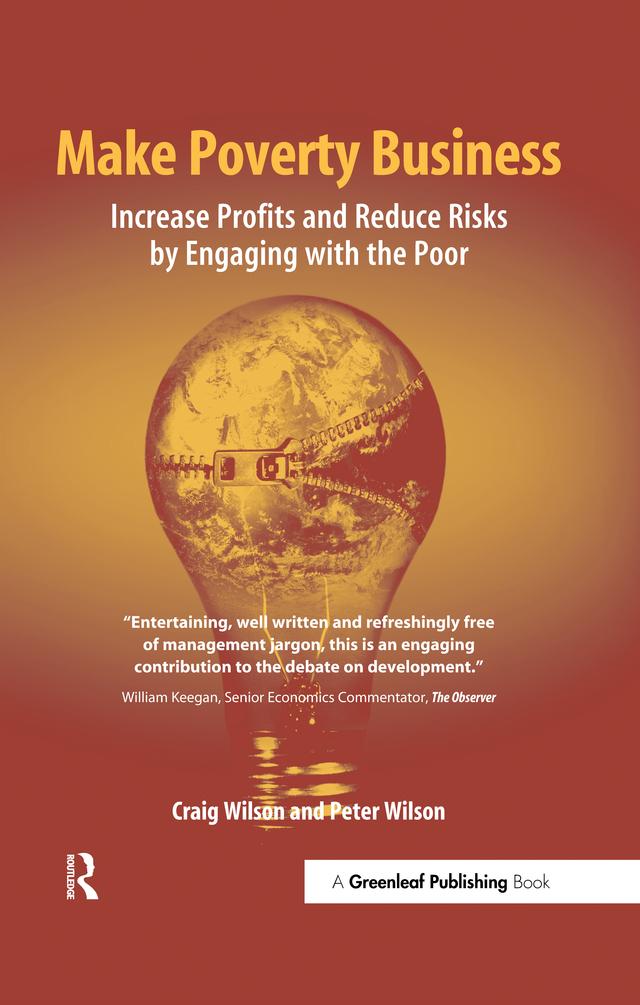
Poor people in developing countries could make excellent suppliers, employees and customers but are often ignored by major businesses. This omission leads to increased risk, higher costs and lower sales. Meanwhile, businesses are asked by governments and poverty activists to do more for economic development, but their exhortations are rarely based on a proper business case. Make Poverty Business bridges the gap by constructing a rigorous profit-making argument for multinational corporations to do more business with the poor. It takes economic development out of the corporate social responsibility ghetto and places it firmly in the core business interests of the corporation, and argues that to see the poor only as potential consumers at the bottom of the pyramid (BOP) misses half of the story.
Make Poverty Business examines the successes, failures and missed opportunities of a wide range of global companies including Wal-Mart, BP, Unilever, Shell and HSBC when dealing with the poor and with development advocates in the media, NGOs, governments and international organisations. It includes a discussion on how to use a poverty perspective to provoke profitable innovation – not only to create new products and services but also to find new sources of competitive advantage in the supply chain and to develop more sustainable, lower-cost business models in developing countries.
Make Poverty Business will be essential reading for international business managers seeking to increase profits and decrease risks in developing countries, development advocates who seek to harness the profit motive to achieve reductions in poverty, and academics looking for practical strategies on how business can implement BOP initiatives in developing countries.
Pay easily by card, Klarna, Apple Pay or Google Pay. Not happy? You always have a 14-day money-back guarantee. Read more in our terms. If you have any questions, email us at hello@memmo.org.
Memmo makes studying easier – wherever you are in the world. We bring your course books and smart study tools together in one place: summaries, quizzes, podcasts and flashcards. Plus Ted, your study buddy who answers anything you wonder. Over 50,000 students already study here – built to help you learn faster and stress less.