
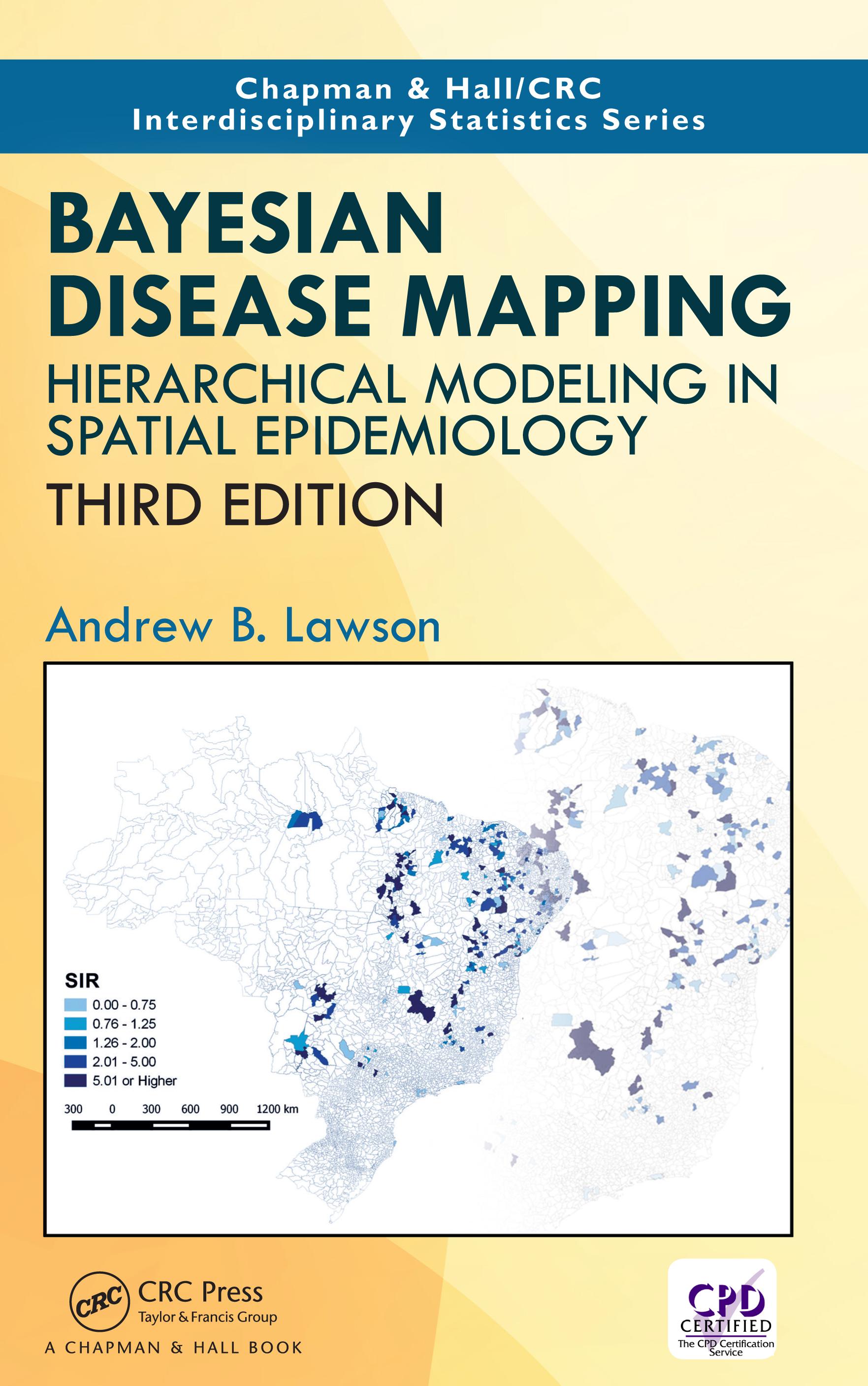
Since the publication of the second edition, many new Bayesian tools and methods have been developed for space-time data analysis, the predictive modeling of health outcomes, and other spatial biostatistical areas. Exploring these new developments, Bayesian Disease Mapping: Hierarchical Modeling in Spatial Epidemiology, Third Edition provides an up-to-date, cohesive account of the full range of Bayesian disease mapping methods and applications.
In addition to the new material, the book also covers more conventional areas such as relative risk estimation, clustering, spatial survival analysis, and longitudinal analysis. After an introduction to Bayesian inference, computation, and model assessment, the text focuses on important themes, including disease map reconstruction, cluster detection, regression and ecological analysis, putative hazard modeling, analysis of multiple scales and multiple diseases, spatial survival and longitudinal studies, spatiotemporal methods, and map surveillance. It shows how Bayesian disease mapping can yield significant insights into georeferenced health data.
The target audience for this text is public health specialists, epidemiologists, and biostatisticians who need to work with geo-referenced health data.
Pay easily by card, Klarna, Apple Pay or Google Pay. Not happy? You always have a 14-day money-back guarantee. Read more in our terms. If you have any questions, email us at hello@memmo.org.
Memmo makes studying easier – wherever you are in the world. We bring your course books and smart study tools together in one place: summaries, quizzes, podcasts and flashcards. Plus Ted, your study buddy who answers anything you wonder. Over 75,000 students already study here – built to help you learn faster and stress less.