
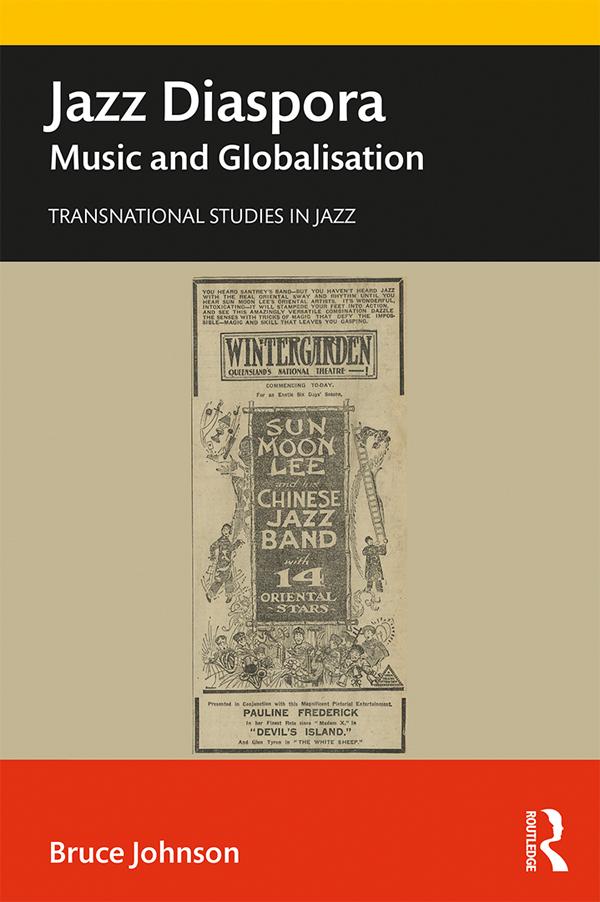
Jazz Diaspora: Music and Globalisation is about the international diaspora of jazz, well underway within a year of the first jazz recordings in 1917. This book studies the processes of the global jazz diaspora and its implications for jazz historiography in general, arguing for its relevance to the fields of sonic studies and cognitive theory. Until the late twentieth century, the historiography and analysis of jazz were centred on the US to the almost complete exclusion of any other region. The driving premise of this book is that jazz was not ‘invented’ and then exported: it was invented in the process of being disseminated.
Jazz Diaspora is a sustained argument for an alternative historiography, based on a shift from a US-centric to a diasporic perspective on the music. The rationale is double-edged. It appears that most of the world’s jazz is experienced (performed and consumed) in diasporic sites – that is, outside its agreed geographical point of origin – and to ignore diasporic jazz is thus to ignore most jazz activity. It is also widely felt that the balance has shifted, as jazz in its homeland has become increasingly conservative.
There has been an assumption that only the ‘authentic’ version of the music--as represented in its country of origin--was of aesthetic and historical interest in the jazz narrative; that the forms that emerged in other countries were simply rather pallid and enervated echoes of the ‘real thing’. This has been accompanied by challenges to the criterion of place- and race-based authenticity as a way of assessing the value of popular music forms in general. As the prototype for the globalisation of popular music, diasporic jazz provides a richly instructive template for the study of the history of modernity as played out musically.
Pay easily by card, Klarna, Apple Pay or Google Pay. Not happy? You always have a 14-day money-back guarantee. Read more in our terms. If you have any questions, email us at hello@memmo.org.
Memmo makes studying easier – wherever you are in the world. We bring your course books and smart study tools together in one place: summaries, quizzes, podcasts and flashcards. Plus Ted, your study buddy who answers anything you wonder. Over 50,000 students already study here – built to help you learn faster and stress less.