
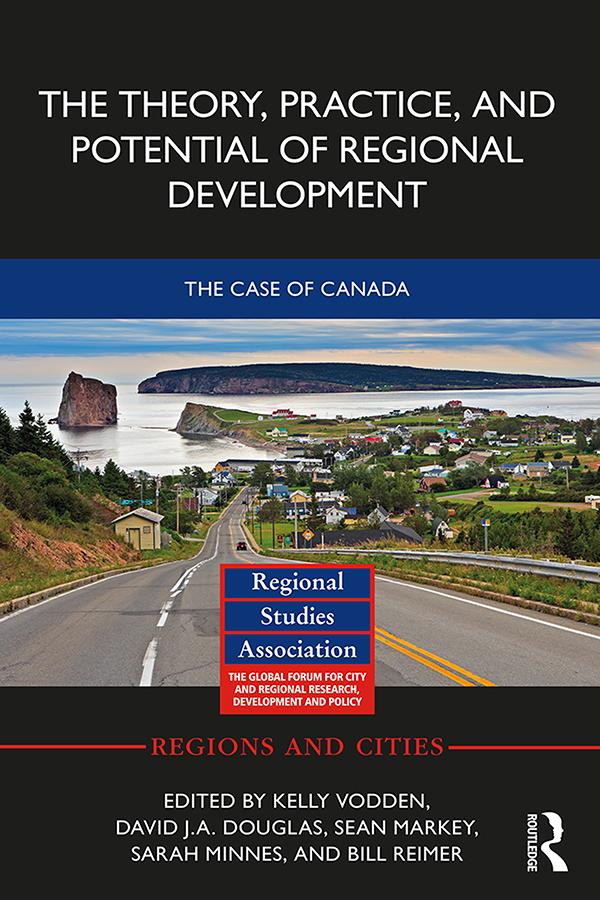
Canadian regional development today involves multiple actors operating within nested scales from local to national and even international levels. Recent approaches to making sense of this complexity have drawn on concepts such as multi-level governance, relational assets, integration, innovation, and learning regions. These new regionalist concepts have become increasingly global in their formation and application, yet there has been little critical analysis of Canadian regional development policies and programs or the theories and concepts upon which many contemporary regional development strategies are implicitly based.
This volume offers the results of five years of cutting-edge empirical and theoretical analysis of changes in Canadian regional development and the potential of new approaches for improving the well-being of Canadian communities and regions, with an emphasis on rural regions. It situates the Canadian approach within comparative experiences and debates, offering the opportunity for broader lessons to be learnt.
This book will be of interest to policy-makers and practitioners across Canada, and in other jurisdictions where lessons from the Canadian experience may be applicable. At the same time, the volume contributes to and updates regional development theories and concepts that are taught in our universities and colleges, and upon which future research and analysis will build.
Pay easily by card, Klarna, Apple Pay or Google Pay. Not happy? You always have a 14-day money-back guarantee. Read more in our terms. If you have any questions, email us at hello@memmo.org.
Memmo makes studying easier – wherever you are in the world. We bring your course books and smart study tools together in one place: summaries, quizzes, podcasts and flashcards. Plus Ted, your study buddy who answers anything you wonder. Over 50,000 students already study here – built to help you learn faster and stress less.