
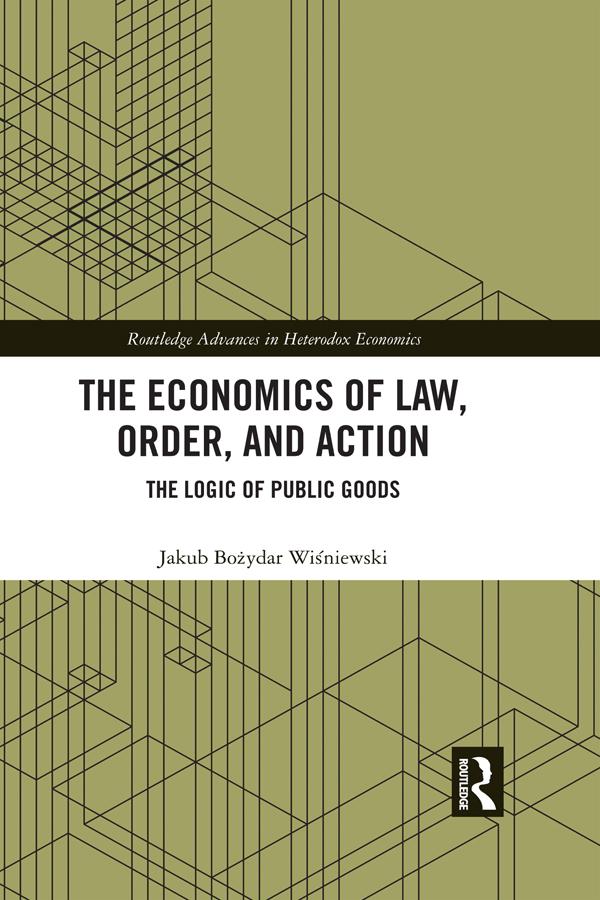
According to the standard position of the economic mainstream, the efficient production of so-called public goods, including law and defense, requires the use of territorial monopolies of coercive force. Two arguments are put forward for this position: a "positive" one, based on the claim that only such institutions can successfully supply society with crucial public goods, and a "negative" one, based on the claim that such institutions by themselves constitute inevitable "public bads".
This book challenges this assumption by utilizing the insights of the Austrian School of Economics, New Institutionalism, constitutional political economy, and other heterodox economic approaches, combined with economically informed ethical analysis. It puts forward a positive case for voluntary social organization that offers new insights into the intersection of economic logic, social philosophy, institutional analysis, and the theory of entrepreneurship. In other words, in an attempt to draw on the interdisciplinary spirit of classical political economy, this book aims at providing a comprehensive economic and ethical case for extending the applicability of voluntary, entrepreneurial cooperation to the realm of creating and sustaining legal and protective services together with attendant institutional frameworks.
Pay easily by card, Klarna, Apple Pay or Google Pay. Not happy? You always have a 14-day money-back guarantee. Read more in our terms. If you have any questions, email us at hello@memmo.org.
Memmo makes studying easier – wherever you are in the world. We bring your course books and smart study tools together in one place: summaries, quizzes, podcasts and flashcards. Plus Ted, your study buddy who answers anything you wonder. Over 50,000 students already study here – built to help you learn faster and stress less.