
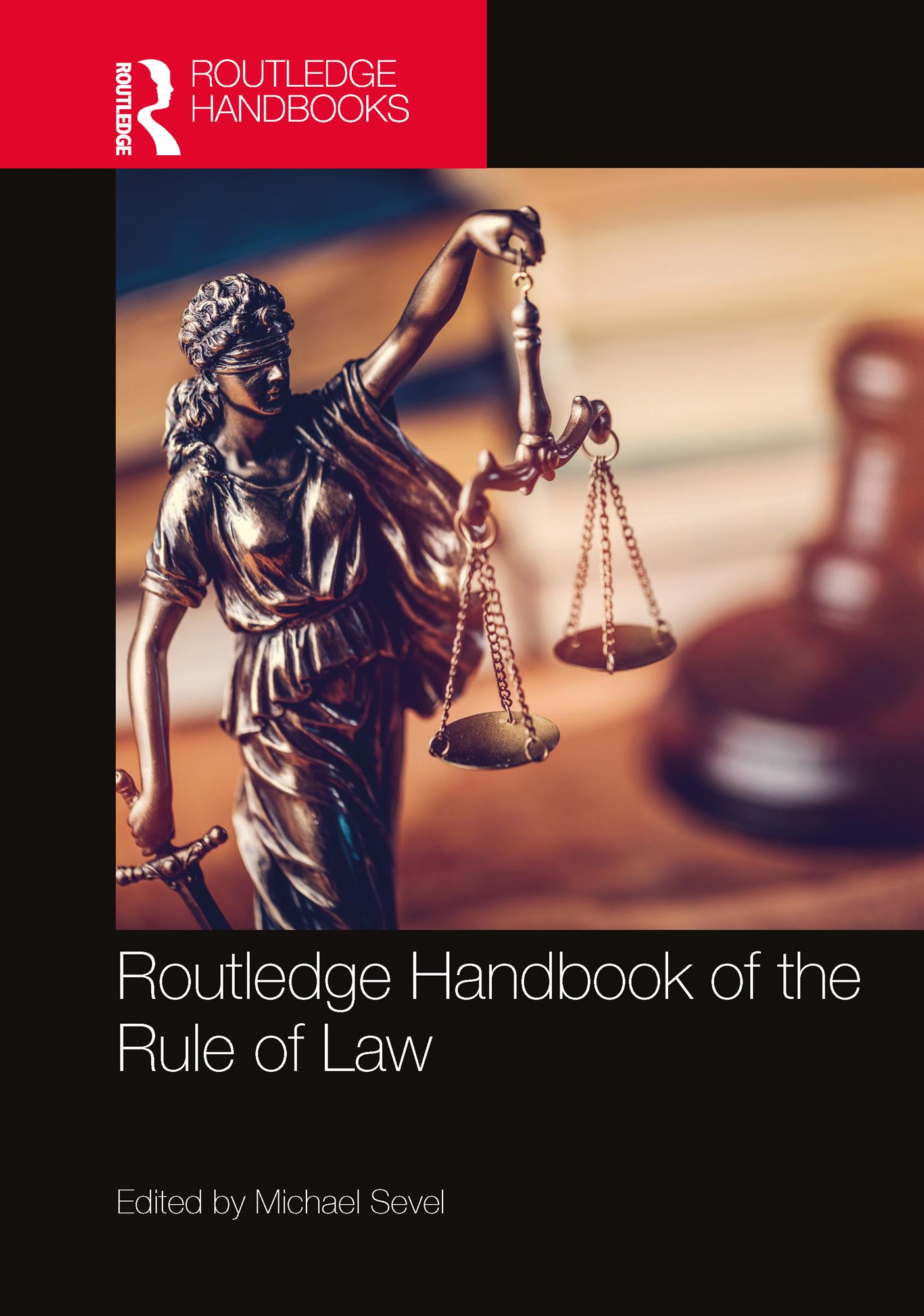
This Handbook provides a state-of-the-art survey of the study of the rule of law across law, the humanities, and social sciences, as well as insights into the practice of building the rule of law within and among states. Its 28 chapters are by many of the world’s leading scholars of the rule of law, as well as distinguished junior scholars, from a dozen countries and representing a number of academic disciplines. The chapters are ordered to progress, first, from theory to the practice of the rule of law and, second, from the rule of law within, to beyond, the state. They divide into three parts. The first part examines the concept, history, and value of the rule of law. This section considers the importance of political and intellectual history in shaping the concept over the centuries and takes novel philosophical approaches to the connection between the rule of law and other important ideals such as justice, equality, and civil disobedience. The second part transitions from theoretical studies to accounts of practical exercises in building the rule of law. The chapters consider the challenges of rule of law reform, including the use of local intermediaries facilitating interactions between international legal aid organizations and state governments, the challenges of legal translation across vastly different societies, the pathways of knowledge among the powerless about the protective potential of the rule of law, as well as the possible future for artificial intelligence systems in helping to reinforce rule-of-law principles. The third part examines the rule of law from a number of perspectives within particular supranational and national states, such as the European Union, China, Singapore, and South Africa, among others, and concludes by considering the prospects of the rule of law beyond the state, both within and among international institutions such as the United Nations, as well as non-territorial spaces like the world’s oceans. This Handbook is aimed at rule of law scholars across law, the humanities, and the social sciences, law and development practitioners, policymakers, and advanced students and researchers who seek a state-of-the-art overview of the history, theory, and practice of the rule of law.
Pay easily by card, Klarna, Apple Pay or Google Pay. Not happy? You always have a 14-day money-back guarantee. Read more in our terms. If you have any questions, email us at hello@memmo.org.
Memmo makes studying easier – wherever you are in the world. We bring your course books and smart study tools together in one place: summaries, quizzes, podcasts and flashcards. Plus Ted, your study buddy who answers anything you wonder. Over 50,000 students already study here – built to help you learn faster and stress less.