
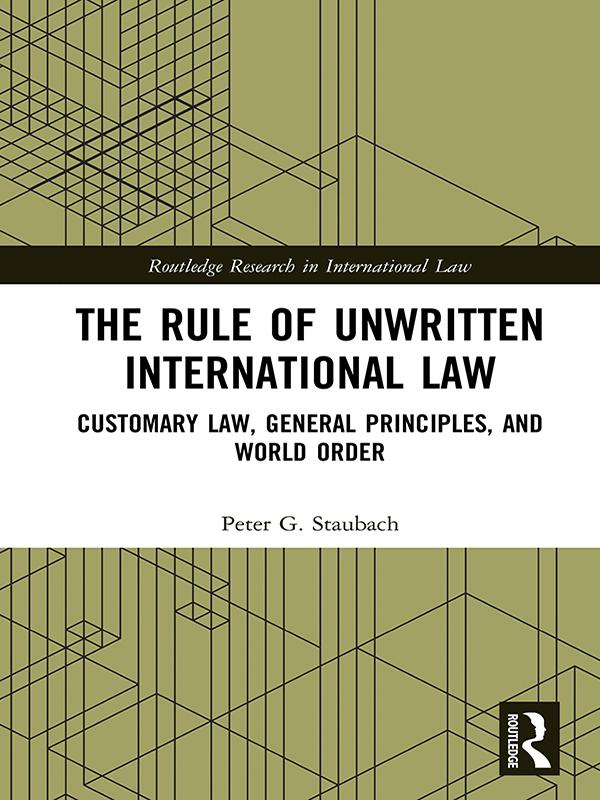
This book seeks to re-appreciate the concept of customary international law as a form of spontaneous societal self-organisation, and to develop the methodological consequences that ensue from this conception for the practice of its application. In pursuing this aim, the author draws from three different strands of scholarship that have not yet been considered in connection with one another: First, general jurisprudential theories of customary law; second, theories of customary international law, especially as they relate to international relations scholarship; and third, methodological approaches to the interpretation of international law. This expansive, philosophical layout of the book enables the author to put the conceptual enigmas of customary international law into a broader perspective.
Among the issues discussed in the book are the dichotomy of its traditional and modern forms and the respective benefits and disadvantages of inductive and deductive approaches to its ascertainment. In the course of this analysis, the author draws insights from Friedrich August Hayek’s theory of law as a ‘spontaneous order’, an information-processing device which enables the participants of a legal system to make use of decentralised knowledge. The book argues that the major advantage of custom as a source of international law lies in the fact that it is the result of a gradual process of trial and error, rather than the product of deliberate planning. This makes it a particularly apposite source of law in a time of seismic shifts in the distribution of power within a vastly diverse community of States, when a new global order is expected to emerge, the contours of which are not yet clearly discernible.
This book applies general concepts of legal philosophy to explain the continuing relevance of custom as a source of international law while at the same time inferring from this theoretical framework concrete practical and methodological consequences, the most important of which is the special role that purposive interpretation plays with respect to rules of international custom. Given this broad approach, the book will be of interest to several groups of potential readers including academics interested in the philosophy of customary law in general, academic international lawyers and legal practitioners, especially judges, scholars of international relations and all those interested in how the international community of States organises itself.
Pay easily by card, Klarna, Apple Pay or Google Pay. Not happy? You always have a 14-day money-back guarantee. Read more in our terms. If you have any questions, email us at hello@memmo.org.
Memmo makes studying easier – wherever you are in the world. We bring your course books and smart study tools together in one place: summaries, quizzes, podcasts and flashcards. Plus Ted, your study buddy who answers anything you wonder. Over 50,000 students already study here – built to help you learn faster and stress less.