
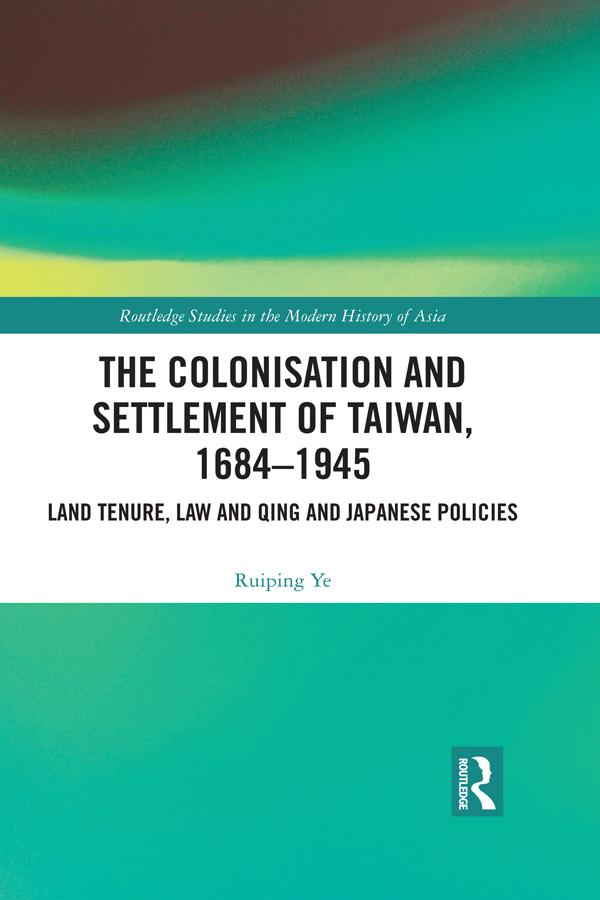
The dispossession of indigenous peoples by conquest regimes remains a pressing issue. This book, unlike most other books on the subject, contrasts two different colonial administrations – first the Chinese Qing Empire, then, from 1895, the Japanese. It shows how, under the Chinese legal system, the Qing employed the Chinese legal system to manage the relationship between the increasing numbers of Han Chinese settlers and the indigenous peoples, and how, although the Qing regime refrained from taking actions to transform aboriginal land tenure, nevertheless Chinese settlers were able to manipulate aboriginal land tenure to their advantage. It goes on to examine the very different approach of the Japanese colonial administration, which following the Meiji Restoration of 1868 had begun to adopt a Western legal framework, demonstrating how this was intentionally much more intrusive, and how the Japanese modernized legal framework significantly disrupted aboriginal land tenure. Based on extensive original research, the book provides important insights into colonisation, different legal traditions and the impact of colonial settlement on indigenous peoples.
Pay easily by card, Klarna, Apple Pay or Google Pay. Not happy? You always have a 14-day money-back guarantee. Read more in our terms. If you have any questions, email us at hello@memmo.org.
Memmo makes studying easier – wherever you are in the world. We bring your course books and smart study tools together in one place: summaries, quizzes, podcasts and flashcards. Plus Ted, your study buddy who answers anything you wonder. Over 50,000 students already study here – built to help you learn faster and stress less.