
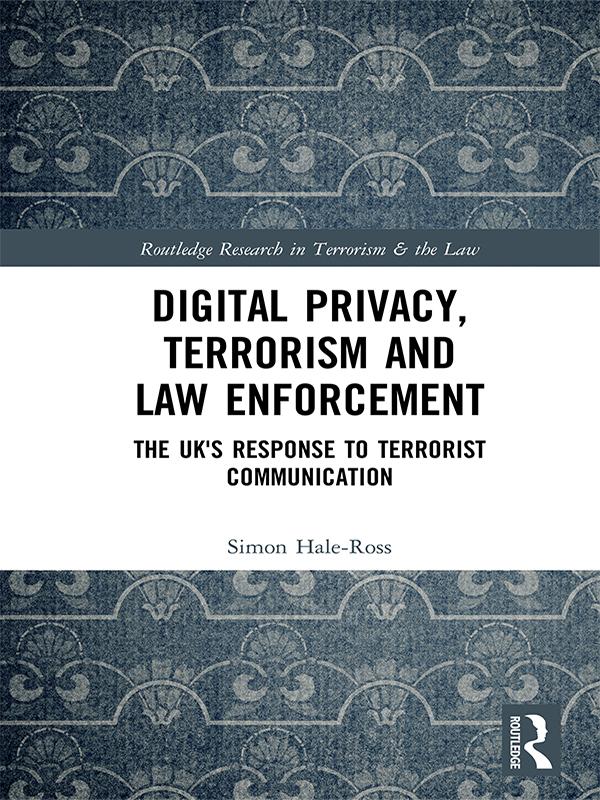
This book examines the UK’s response to terrorist communication. Its principle question asks, has individual privacy and collective security been successfully managed and balanced? The author begins by assessing several technologically-based problems facing British law enforcement agencies, including use of the Internet; the existence of ‘darknet’; untraceable Internet telephone calls and messages; smart encrypted device direct messaging applications; and commercially available encryption software. These problems are then related to the traceability and typecasting of potential terrorists, showing that law enforcement agencies are searching for needles in the ever-expanding haystacks. To this end, the book examines the bulk powers of digital surveillance introduced by the Investigatory Powers Act 2016. The book then moves on to assess whether these new powers and the new legislative safeguards introduced are compatible with international human rights standards.
The author creates a ‘digital rights criterion’ from which to challenge the bulk surveillance powers against human rights norms. Lord Carlile of Berriew CBE QC in recommending this book notes this particular legal advancement, commenting that rightly so the author concludes the UK has fairly balanced individual privacy with collective security.
The book further analyses the potential impact on intelligence exchange between the EU and the UK, following Brexit. Using the US as a case study, the book shows that UK laws must remain within the ambit of EU law and the Court of Justice of the European Union's (CJEU's) jurisprudence, to maintain the effectiveness of the exchange. It addresses the topics with regard to terrorism and counterterrorism methods and will be of interest to researchers, academics, professionals, and students researching counterterrorism and digital electronic communications, international human rights, data protection, and international intelligence exchange.
Pay easily by card, Klarna, Apple Pay or Google Pay. Not happy? You always have a 14-day money-back guarantee. Read more in our terms. If you have any questions, email us at hello@memmo.org.
Memmo makes studying easier – wherever you are in the world. We bring your course books and smart study tools together in one place: summaries, quizzes, podcasts and flashcards. Plus Ted, your study buddy who answers anything you wonder. Over 50,000 students already study here – built to help you learn faster and stress less.