
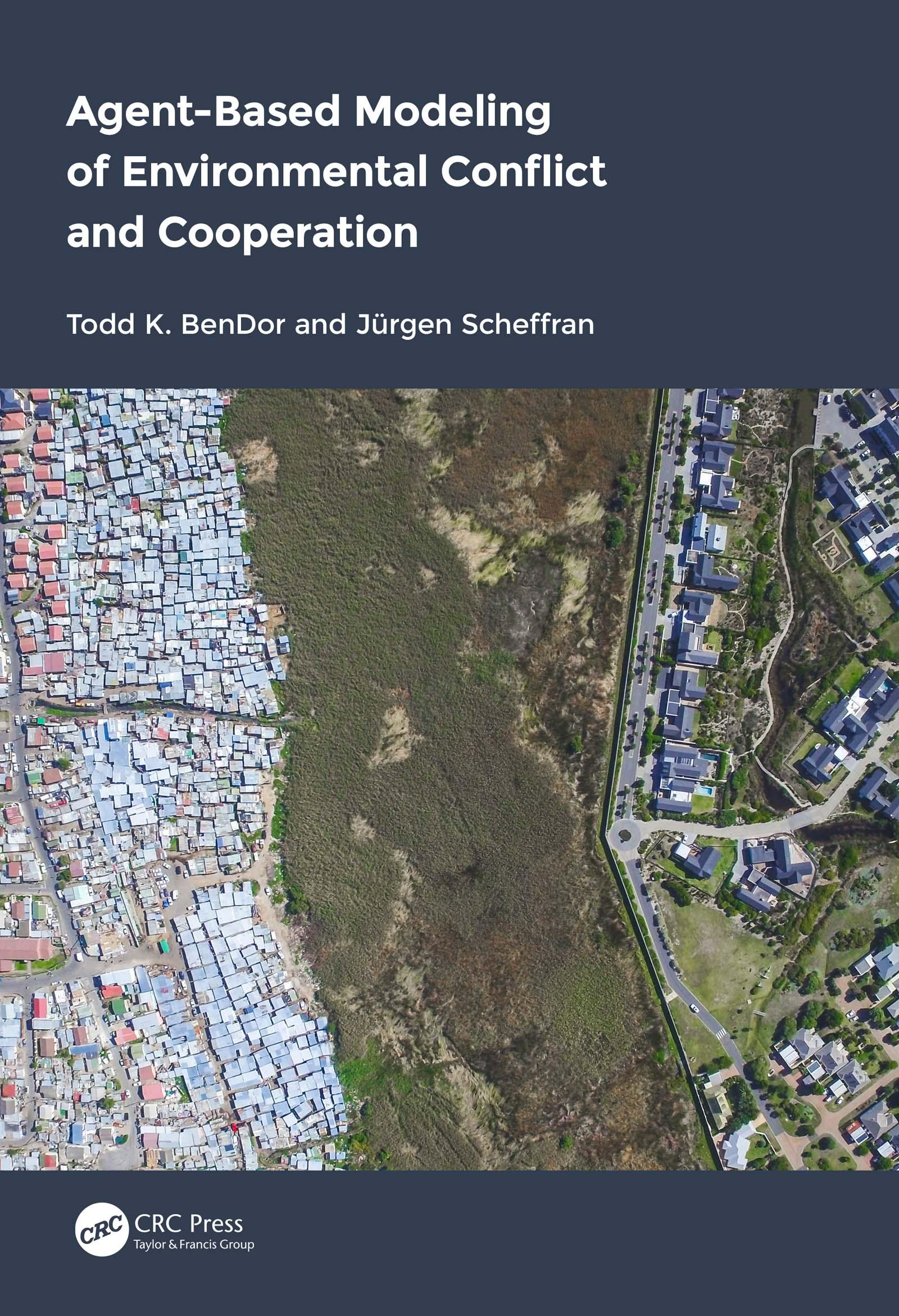
Conflict is a major facet of many environmental challenges of our time. However, growing conflict complexity makes it more difficult to identify win-win strategies for sustainable conflict resolution. Innovative methods are needed to help predict, understand, and resolve conflicts in cooperative ways.
Agent-Based Modeling of Environmental Conflict and Cooperation examines computer modeling techniques as an important set of tools for assessing environmental and resource-based conflicts and, ultimately, for finding pathways to conflict resolution and cooperation. This book has two major goals. First, it argues that complexity science can be a unifying framework for professions engaged in conflict studies and resolution, including anthropology, law, management, peace studies, urban planning, and geography. Second, this book presents an innovative framework for approaching conflicts as complex adaptive systems by using many forms of environmental analysis, including system dynamics modeling, agent-based modeling, evolutionary game theory, viability theory, and network analysis. Known as VIABLE (Values and Investments from Agent-Based interaction and Learning in Environmental systems), this framework allows users to model advanced facets of conflicts—including institution building, coalition formation, adaptive learning, and the potential for future conflict—and conflict resolution based on the long-term viability of the actors’ strategies.
Written for scholars, students, practitioners, and policy makers alike, this book offers readers an extensive introduction to environmental conflict research and resolution techniques. As the result of decades of research, the text presents a strong argument for conflict modeling and reviews the most popular and advanced techniques, including system dynamics modeling, agent-based modeling, and participatory modeling methods. This indispensable guide uses NetLogo, a widely used and free modeling software package, to implement the VIABLE modeling approach in three case study applications around the world. Readers are invited to explore, adapt, modify, and expand these models to conflicts they hope to better understand and resolve.
Pay easily by card, Klarna, Apple Pay or Google Pay. Not happy? You always have a 14-day money-back guarantee. Read more in our terms. If you have any questions, email us at hello@memmo.org.
Memmo makes studying easier – wherever you are in the world. We bring your course books and smart study tools together in one place: summaries, quizzes, podcasts and flashcards. Plus Ted, your study buddy who answers anything you wonder. Over 50,000 students already study here – built to help you learn faster and stress less.