
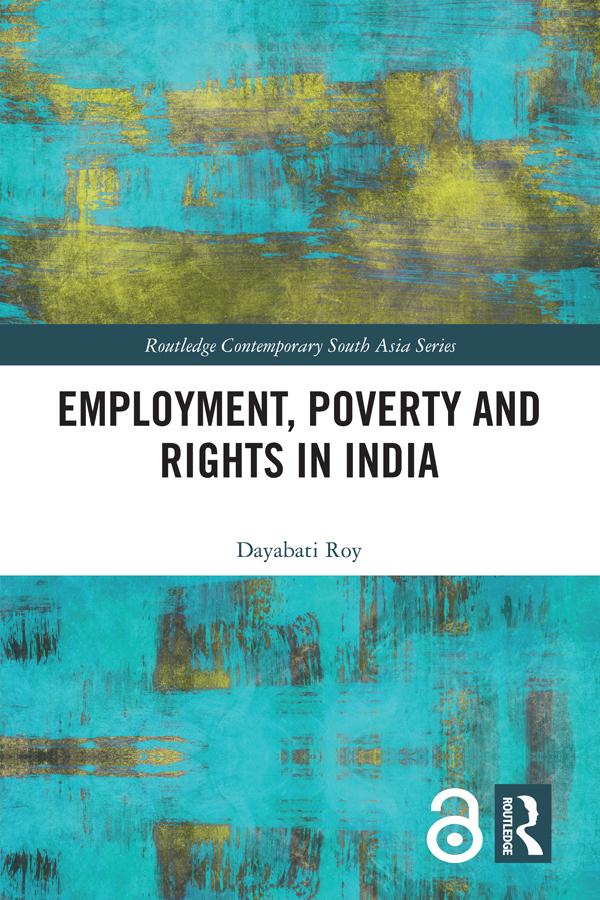
In comparison to other social groups, India’s rural poor – and particularly Adivasis and Dalits - have seen little benefit from the country’s economic growth over the last three decades. Though economists and statisticians are able to model the form and extent of this inequality, their work is rarely concerned with identifying possible causes.
Employment, Poverty and Rights in India analyses unemployment in India and explains why the issues of employment and unemployment should be the appropriate prism to understand the status of wellbeing in India. The author provides a historical analysis of policy interventions on behalf of the colonial and postcolonial state with regard to the alleviation of unemployment and poverty in India and in West Bengal in particular. Arguing that, as long as poverty - either as a concept or as an empirical condition - remains as a technical issue to be managed by governmental technologies, the ‘poor’ will be held responsible for their own fate and the extent of poverty will continue to increase. The book contends that rural unemployment in India is not just an economic issue but a political process that has consistently been shaped by various socio-economic, political and cultural factors since the colonial period. The analysis which depends mainly on ethnography extends to the implementation of the ‘New Rights Agenda’, such as the MGNREGA, at the rural margin.
Challenging the dominant approach to poverty, this book will be of interest to scholars working in the fields of South Asian studies, Indian Political Economy, contemporary political theories, poverty studies, neo-liberalism, sociology and social anthropology as well as development studies.
Pay easily by card, Klarna, Apple Pay or Google Pay. Not happy? You always have a 14-day money-back guarantee. Read more in our terms. If you have any questions, email us at hello@memmo.org.
Memmo makes studying easier – wherever you are in the world. We bring your course books and smart study tools together in one place: summaries, quizzes, podcasts and flashcards. Plus Ted, your study buddy who answers anything you wonder. Over 50,000 students already study here – built to help you learn faster and stress less.