
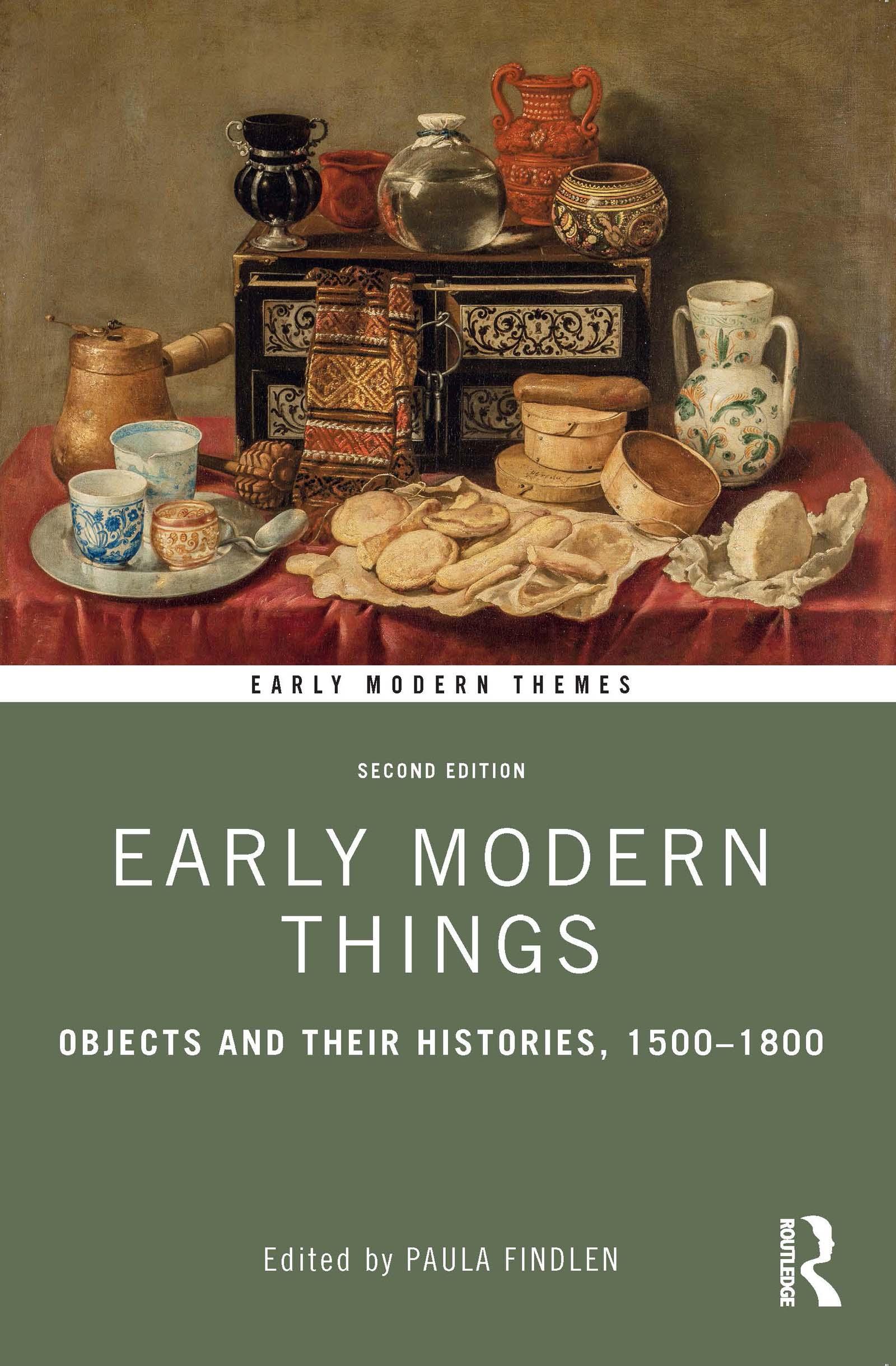
Early Modern Things supplies fresh and provocative insights into how objects – ordinary and extraordinary, secular and sacred, natural and man-made – came to define some of the key developments of the early modern world.
Now in its second edition, this book taps a rich vein of recent scholarship to explore a variety of approaches to the material culture of the early modern world (c. 1500–1800). Divided into seven parts, the book explores the ambiguity of things, representing things, making things, encountering things, empires of things, consuming things, and the power of things. This edition includes a new preface and three new essays on ‘encountering things’ to enrich the volume. These look at cabinets of curiosities, American pearls, and the material culture of West Central Africa. Spanning across the early modern world from Ming dynasty China and Tokugawa Japan to Siberia and Georgian England, from the Kingdom of the Kongo and the Ottoman Empire to the Caribbean and the Spanish Americas, the authors provide a generous set of examples in how to study the circulation, use, consumption, and, most fundamentally, the nature of things themselves.
Drawing on a broad range of disciplinary perspectives and lavishly illustrated, this updated edition of Early Modern Things is essential reading for all those interested in the early modern world and the history of material culture.
Pay easily by card, Klarna, Apple Pay or Google Pay. Not happy? You always have a 14-day money-back guarantee. Read more in our terms. If you have any questions, email us at hello@memmo.org.
Memmo makes studying easier – wherever you are in the world. We bring your course books and smart study tools together in one place: summaries, quizzes, podcasts and flashcards. Plus Ted, your study buddy who answers anything you wonder. Over 50,000 students already study here – built to help you learn faster and stress less.