
A picture has indeed held modern Western philosophy captive, that of the universe as a vast machine whose iron laws are best understood as exceptionless empirical regularities which, as it were, determine the future before it happens. This fantastic conception commands the assent, not just of positivistically-minded naturalists but of all the great anti-naturalists who champion a very different view of human action as a domain of freedom ‘that somehow cheats science’.
The most fundamental move in Roy Bhaskar’s system of philosophy, the germ of everything that followed, was to reconceptualise the natural world in transcendental realist terms, ‘turning Kant around using his own method’. On this account, the universe is characterized by deep structures, mechanisms and fields that generate the flux of phenomena, and is in open, creative and emergent process. This completely recasts the terms of the debate between naturalism and anti-naturalism by remedying its false grounds and shows how philosophy can be liberated from its anthropocentric/anthropomorphic prison and rendered consistent with the best insights of modern natural science. There is necessity in nature quite independent of humans, but in an open world causation is multiple and conjunctural, the actual course of the unfolding of being is highly contingent and the bases of human freedom can be understood scientifically.
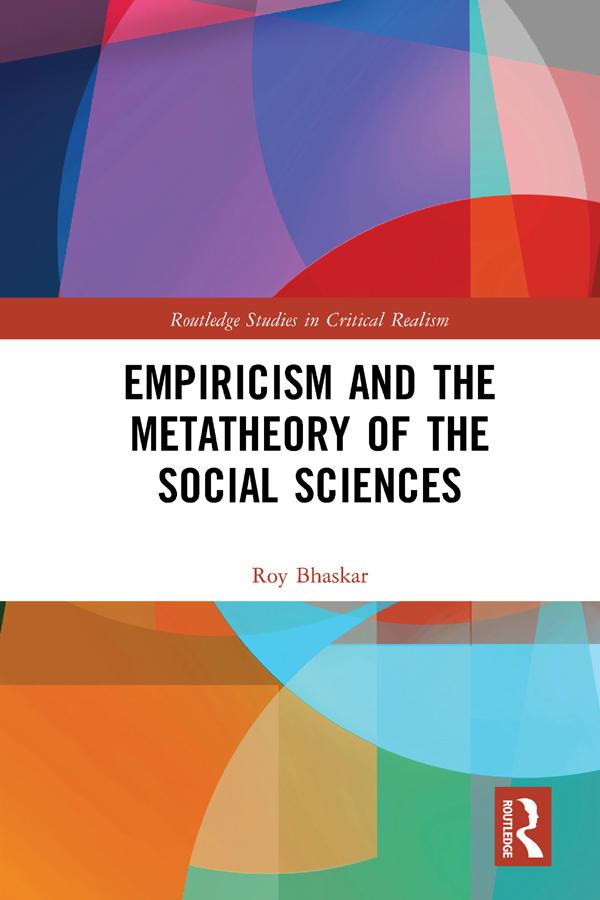
Written as a DPhil thesis when Bhaskar was in his mid-twenties, Empiricism and the Metatheory of the Social Sciences brilliantly launches this reconceptualisation and explores its implications for social science in the course of carrying through the metatheoretical destruction of empiricism. It will be indispensable reading for anyone interested in the development of Bhaskar’s thought, in transcendental realism, and in the critique of empiricism, more generally of the philosophical discourse of Western modernity.
Pay easily by card, Klarna, Apple Pay or Google Pay. Not happy? You always have a 14-day money-back guarantee. Read more in our terms. If you have any questions, email us at hello@memmo.org.
Memmo makes studying easier – wherever you are in the world. We bring your course books and smart study tools together in one place: summaries, quizzes, podcasts and flashcards. Plus Ted, your study buddy who answers anything you wonder. Over 50,000 students already study here – built to help you learn faster and stress less.