
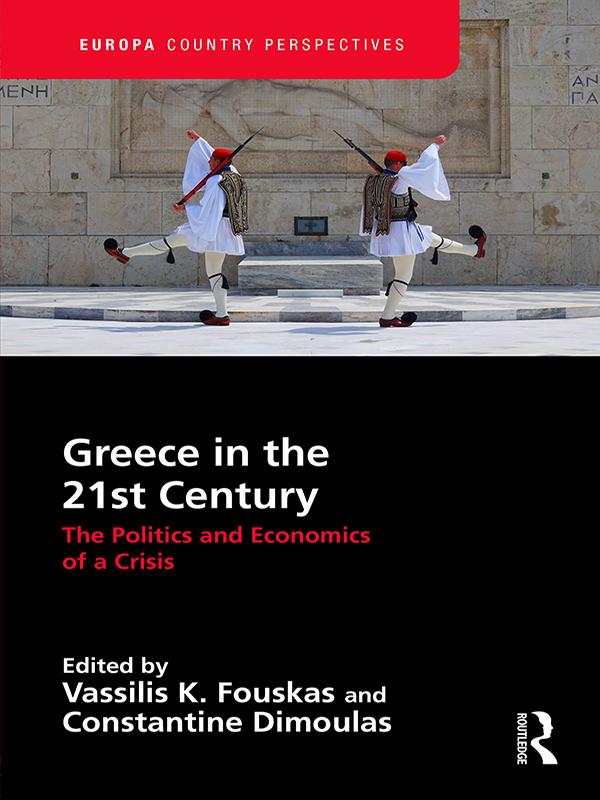
For most of the first part of the 21st century Greece has been seen as a critical battlefield for the survival of the powerful and the adjustment or extinction of the weak, as if all the historical contradictions of the global financial crisis and the eurozone crisis were concentrated in that tiny part of the world, with a population of just 11 million people and a GDP of less than 2% of that of the European Union as a whole. While the country has been overpowered by the disciplinarian and deeply authoritarian policy mix of ordoliberal/neoliberal rules, as this book attempts to show, there is hope. Defeat does not end the crisis, and crisis means constant opportunity. In this state of affairs, all types of agencies try to take advantage of the conditions and opportunities in order to advance towards positions of power and provide the best of solutions for the class interests they represent. Thus, harsh conflict is inevitable and if history provides a yardstick, it is that in periods of conflict and crisis, the winner, usually, is the one who manages to strike the right political and social alliances at the right time.
The editors have assembled in this volume a number of interdisciplinary chapters and arguments which, despite their differences, share the strategic aim of a critique of both neoliberalism/ordoliberalism and new authoritarianism. Chapters examine the eurozone crisis from a variety of angles with reference to Greece, and Greek politics and society. With this collection of heterodox and scholarly essays, the authors and editors aim to offer a progressive understanding of current historical circumstances.
Constantine Dimoulas is an Assistant Professor in social administration and evaluation of social programmes at Panteion University, Greece.
Vassilis K. Fouskas is Professor of international politics and economics at the University of East London, UK, and the founding editor of the Journal of Balkan and Near Eastern Studies (Taylor & Francis).
Pay easily by card, Klarna, Apple Pay or Google Pay. Not happy? You always have a 14-day money-back guarantee. Read more in our terms. If you have any questions, email us at hello@memmo.org.
Memmo makes studying easier – wherever you are in the world. We bring your course books and smart study tools together in one place: summaries, quizzes, podcasts and flashcards. Plus Ted, your study buddy who answers anything you wonder. Over 50,000 students already study here – built to help you learn faster and stress less.