
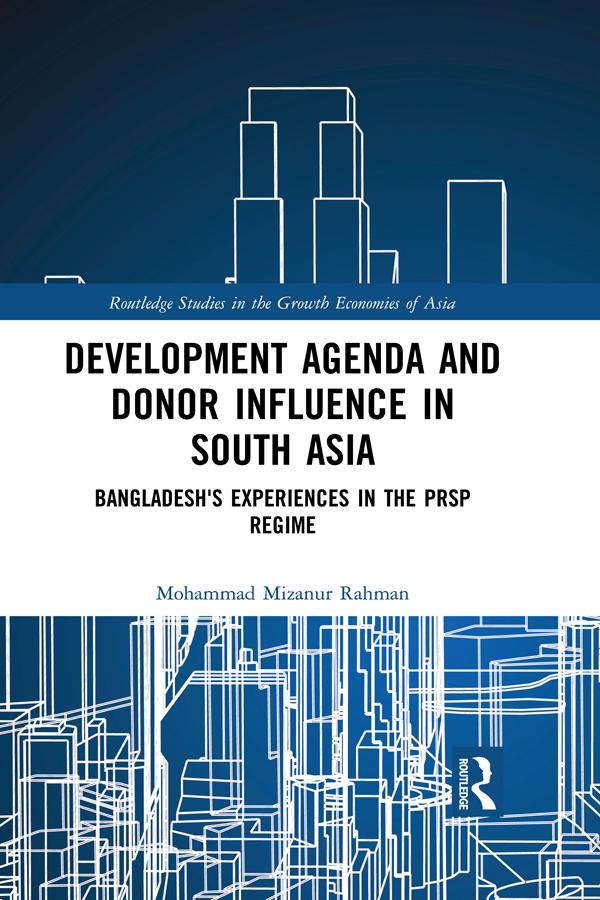
Policy ownership of development agenda emerged as an important aspect in international development cooperation during the 1990s in the wake of evident failures of reform initiatives in developing countries steered by donor agencies, particularly the international financial institutions (IFIs), the World Bank (WB) and the International Monetary Fund (IMF).
The principal focus of this book is to examine Bangladesh’s policy ownership in its PRSP by broadly analyzing the dynamics in the formulation process and examining the principal actors’ contribution to the formulation process. This book also deals with several other dimensions of foreign aid and its changing features including the shifts in WB-IMF’s approach to development cooperation. This book argues that the WB-IMF strongly influence Bangladesh’s development strategies and agendas and in general the WB-IMF have not changed much in their aid relationship despite clear limitations of their previous reform models. Building on Bangladesh’s current level of development the book advocates that Bangladesh needs to adopt a new model for development agenda setting.
Illustrating the influences of donor communities on the creation of development strategies in developing countries, this book presents a macro dynamics of the political economy of international development cooperation. It will be of interest to academics and professionals working on political economy, governance, public policy and development cooperation as well as South Asian Studies.
Pay easily by card, Klarna, Apple Pay or Google Pay. Not happy? You always have a 14-day money-back guarantee. Read more in our terms. If you have any questions, email us at hello@memmo.org.
Memmo makes studying easier – wherever you are in the world. We bring your course books and smart study tools together in one place: summaries, quizzes, podcasts and flashcards. Plus Ted, your study buddy who answers anything you wonder. Over 50,000 students already study here – built to help you learn faster and stress less.