
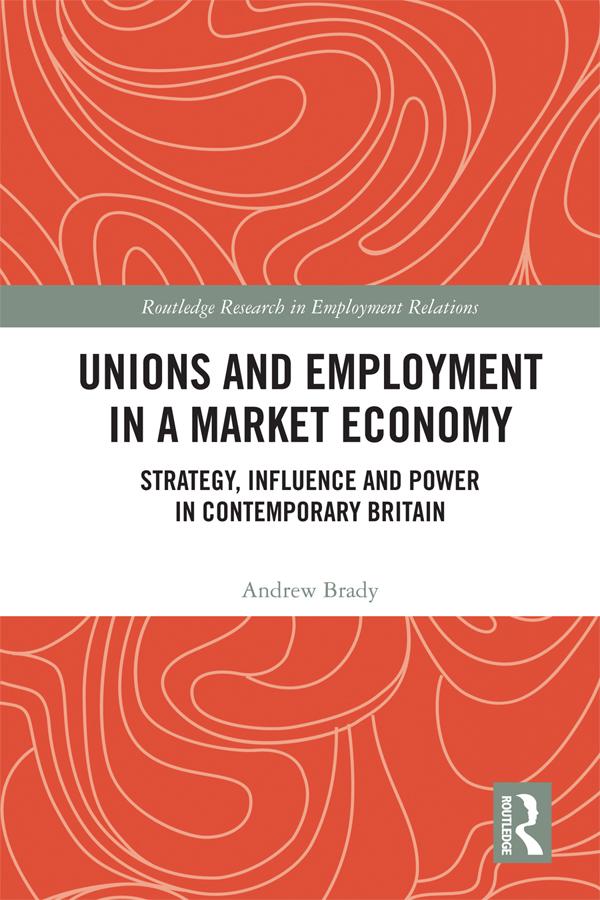
Due to the sharp declines in trade union density and collective bargaining coverage post-1979, the shift by trade unions towards political action has had significant implications for employment relations regulation in contemporary Britain. Yet, there remains insufficient discussion of the factors of influence affecting changes in the political action process from a historical and contemporary perspective. Unions and Employment in a Market Economy will evidence how trade unions were able to offset environmental constraints through a progressive focus on political action, despite diminished power in the Labour Party’s structures and the wider economy. The book presents four legislative events categorised as functional equivalents enacted in two different periods of Labour governance (1974-79 and 1997-2010). The selected events are the Social Contract (1974-79), National Minimum Wage (1998), Employment Relations Act (1999) and the Warwick Agreement (2004). The book’s findings lend credence to the proposition that in a liberal market economy there is a valuable dividend associated with trade union political exchange through the Labour Party.
Pay easily by card, Klarna, Apple Pay or Google Pay. Not happy? You always have a 14-day money-back guarantee. Read more in our terms. If you have any questions, email us at hello@memmo.org.
Memmo makes studying easier – wherever you are in the world. We bring your course books and smart study tools together in one place: summaries, quizzes, podcasts and flashcards. Plus Ted, your study buddy who answers anything you wonder. Over 50,000 students already study here – built to help you learn faster and stress less.