
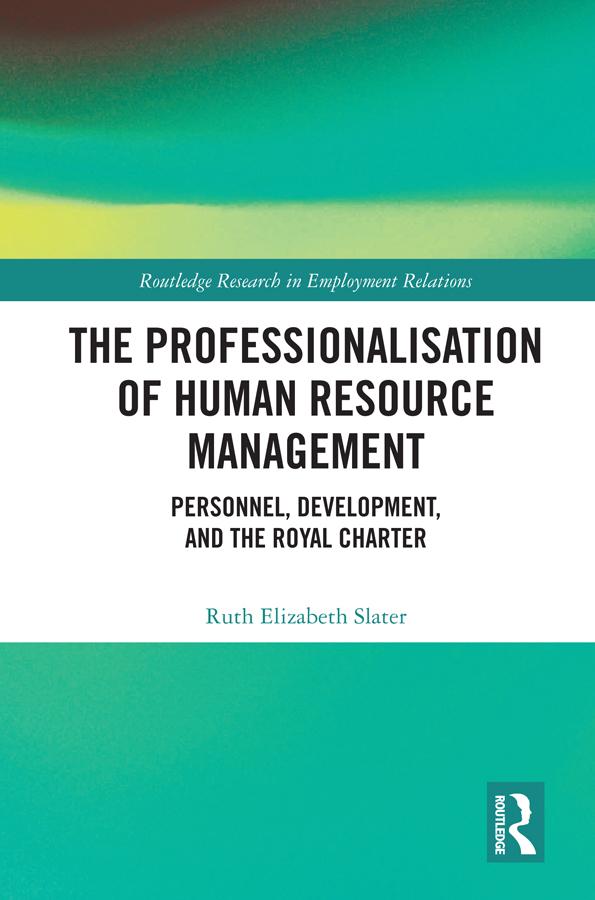
Evolving economies, the emergence of new technologies and organisational forms are all features of late capitalism. Among this milieu, a marked feature has been the emergence and recognition in society of new occupations. The claim upon a body of knowledge and practice, and a societal domain in which to exercise expertise characterise these occupations. Status and recognition may ensue; in short, they claim ‘professionalism’. ‘Professionalism’ is a word resonant with allusions to a particular time and place, loosely located in the United States and England in the twentieth century, although its roots are far earlier, and its present branches are far-reaching.
The text is an account of the Human Resource Management occupation’s search for status, legitimacy, and "professionalism" and illustrates how key agents wove a purposeful plan in pursuit of goals through changing socio-economic and political contexts.
The text also discusses the changed meanings of and opportunities for professionalism for individual agents, as members of a social grouping that is the occupation.
This text is an analysis of the recent development of the Human Resource occupation, against the backdrop of changing meanings and models of professions and professionalism and the traditional signifier of professionalism in the U.K., the Royal Charter. The original research from the UK outlines the efforts undertaken between 1968 and 2000 by the professional body, the present day Chartered Institute of Personnel and Development (CIPD, the Institute), to attain a Royal Charter.
This text addresses the following:
• The role of key agents and institutions on shaping social structures and practice regimes
• The changing construction and meanings of professionalism and professional occupations
• The role of the collective professional body in shaping occupational practices in Human Resource Management and Human Resource Development and their effect upon working lives
• The continuing significance of the Royal Charter as an ancient institution with deep societal effect
Pay easily by card, Klarna, Apple Pay or Google Pay. Not happy? You always have a 14-day money-back guarantee. Read more in our terms. If you have any questions, email us at hello@memmo.org.
Memmo makes studying easier – wherever you are in the world. We bring your course books and smart study tools together in one place: summaries, quizzes, podcasts and flashcards. Plus Ted, your study buddy who answers anything you wonder. Over 50,000 students already study here – built to help you learn faster and stress less.