
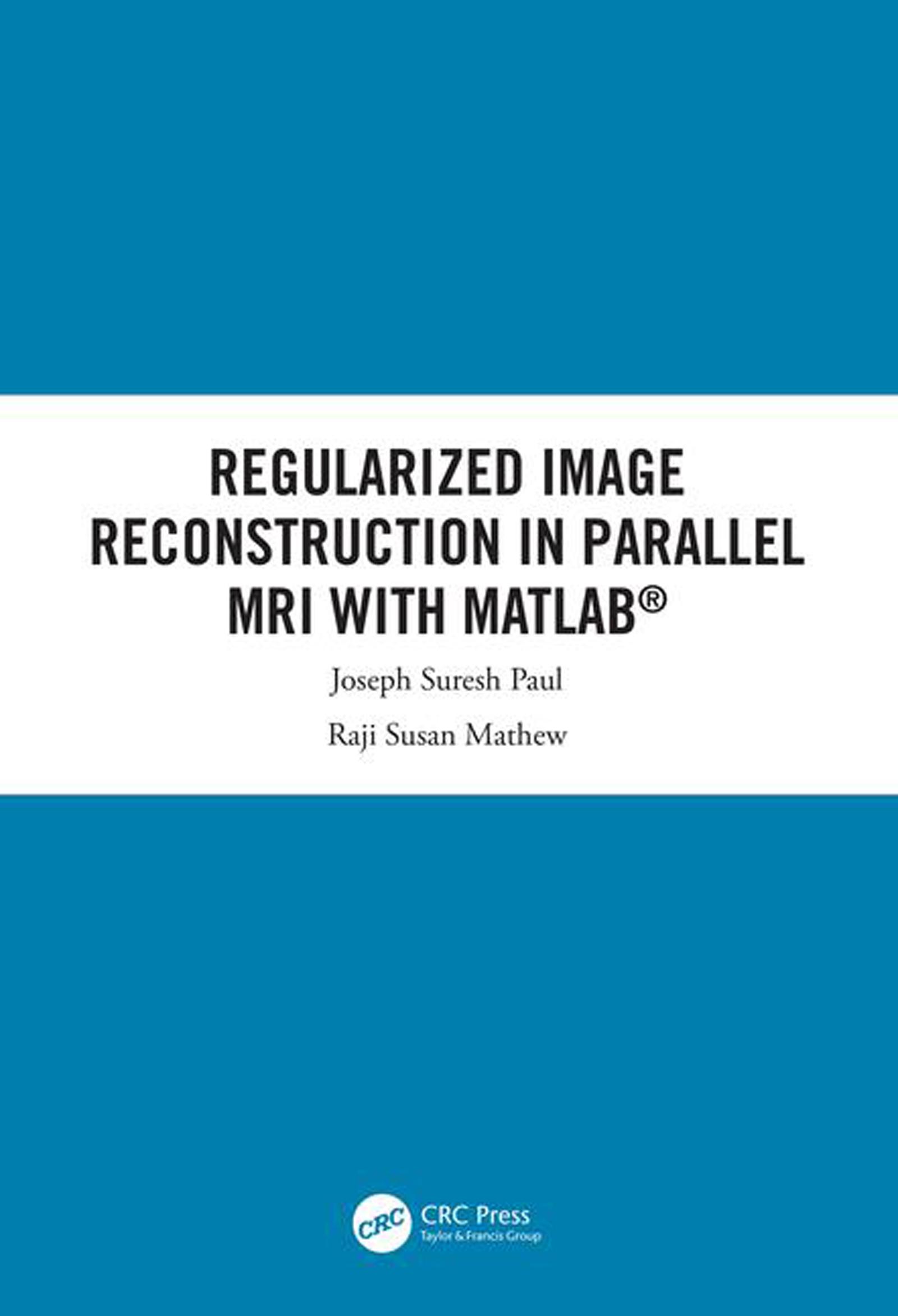
Regularization becomes an integral part of the reconstruction process in accelerated parallel magnetic resonance imaging (pMRI) due to the need for utilizing the most discriminative information in the form of parsimonious models to generate high quality images with reduced noise and artifacts. Apart from providing a detailed overview and implementation details of various pMRI reconstruction methods, Regularized image reconstruction in parallel MRI with MATLAB examples interprets regularized image reconstruction in pMRI as a means to effectively control the balance between two specific types of error signals to either improve the accuracy in estimation of missing samples, or speed up the estimation process. The first type corresponds to the modeling error between acquired and their estimated values. The second type arises due to the perturbation of k-space values in autocalibration methods or sparse approximation in the compressed sensing based reconstruction model.
Features:
- Provides details for optimizing regularization parameters in each type of reconstruction.
- Presents comparison of regularization approaches for each type of pMRI reconstruction.
- Includes discussion of case studies using clinically acquired data.
- MATLAB codes are provided for each reconstruction type.
- Contains method-wise description of adapting regularization to optimize speed and accuracy.
This book serves as a reference material for researchers and students involved in development of pMRI reconstruction methods. Industry practitioners concerned with how to apply regularization in pMRI reconstruction will find this book most useful.
Pay easily by card, Klarna, Apple Pay or Google Pay. Not happy? You always have a 14-day money-back guarantee. Read more in our terms. If you have any questions, email us at hello@memmo.org.
Memmo makes studying easier – wherever you are in the world. We bring your course books and smart study tools together in one place: summaries, quizzes, podcasts and flashcards. Plus Ted, your study buddy who answers anything you wonder. Over 50,000 students already study here – built to help you learn faster and stress less.