
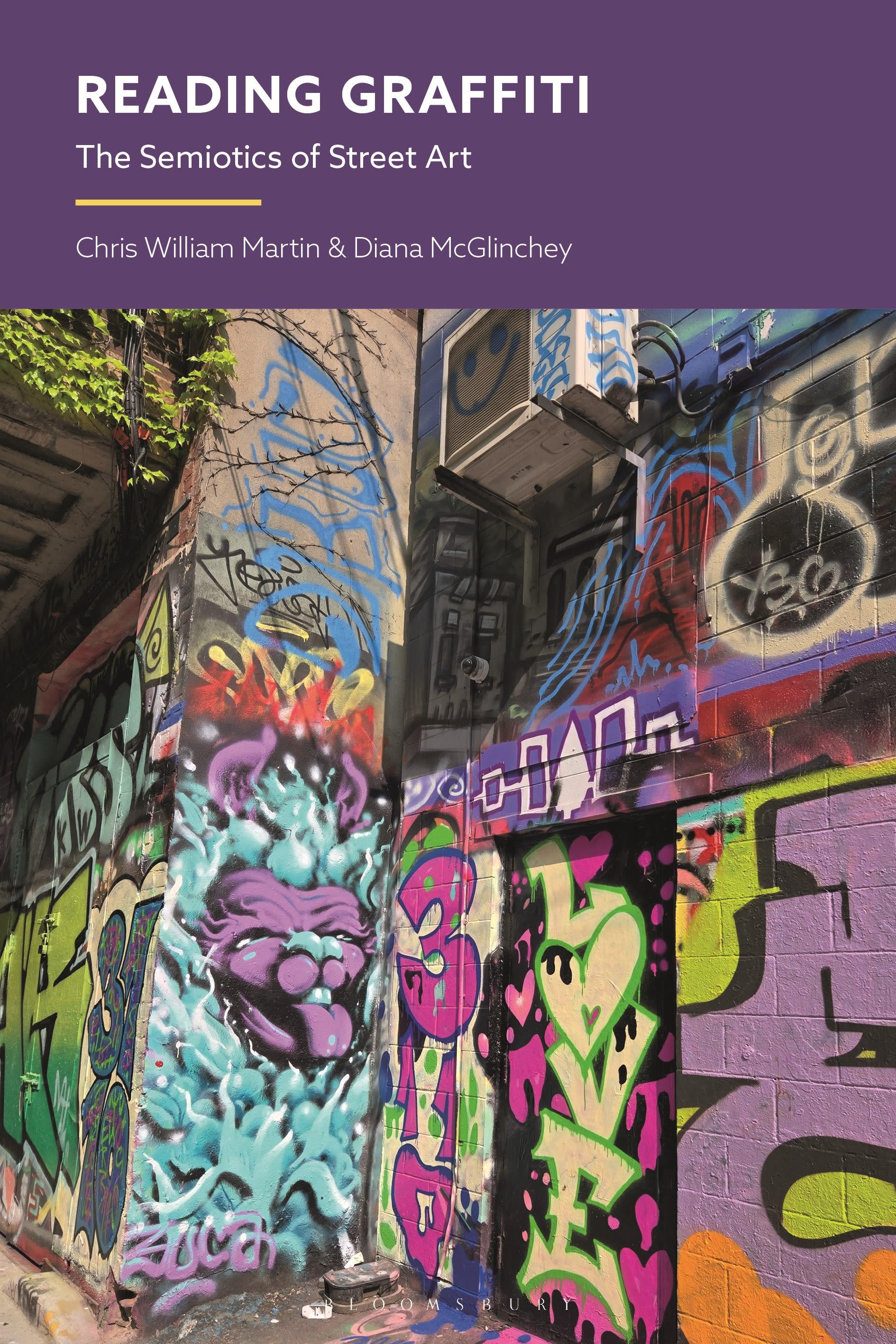
This book examines the language of the varied types of graffiti and street art while uncovering the contemporary uses and purpose behind our need to tag out our existence through letters and images on buildings and city blocks.
Graffiti is as much about our need for art as expression-providing voice for the voiceless-as it is our need for beauty, social criticism, or civil disruption in our environments. This book takes an approach to understanding the ways in which graffiti and street art has changed the way we look at our environments, our social institutions, and ourselves.
The book is informed by an immersive literature review, research at the Museum of Graffiti in Miami, Florida, research, and conversations with local street artists practicing in genres like stickers/slaps, lettering, murals, miniatures/installations, culture jamming and ad busting. It is also informed by fieldnotes of street art tours around the world to explore the semiotic landscape of locales and the impact on the local street art cultures.
Through the polysemy of the word “graffiti” we see cultural history and modern-day actors, graffiti becomes a thing and a practice. It is human and it is historical.
Graffiti is as much about our need for art as expression-providing voice for the voiceless-as it is our need for beauty, social criticism, or civil disruption in our environments. This book takes an approach to understanding the ways in which graffiti and street art has changed the way we look at our environments, our social institutions, and ourselves.
The book is informed by an immersive literature review, research at the Museum of Graffiti in Miami, Florida, research, and conversations with local street artists practicing in genres like stickers/slaps, lettering, murals, miniatures/installations, culture jamming and ad busting. It is also informed by fieldnotes of street art tours around the world to explore the semiotic landscape of locales and the impact on the local street art cultures.
Through the polysemy of the word “graffiti” we see cultural history and modern-day actors, graffiti becomes a thing and a practice. It is human and it is historical.
Pay easily by card, Klarna, Apple Pay or Google Pay. Not happy? You always have a 14-day money-back guarantee. Read more in our terms. If you have any questions, email us at hello@memmo.org.
Memmo makes studying easier – wherever you are in the world. We bring your course books and smart study tools together in one place: summaries, quizzes, podcasts and flashcards. Plus Ted, your study buddy who answers anything you wonder. Over 50,000 students already study here – built to help you learn faster and stress less.