
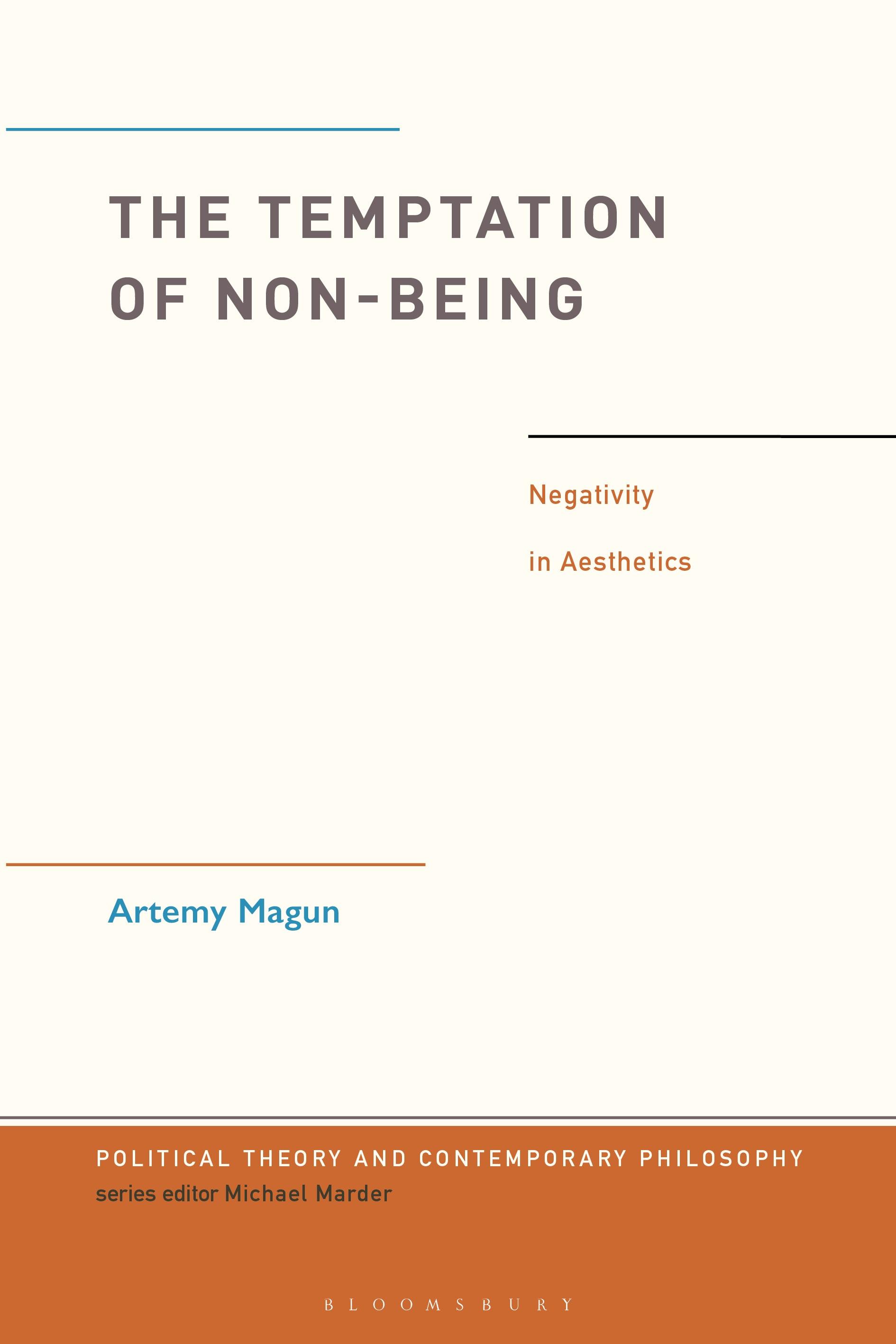
Why do we enjoy artworks that depict disasters and suffering? Is this a hangover from the Modernist impulse to break the rules of harmony? Is there actually a proper way to perform negativity in art without resorting to nihilism? The Temptation of Non-Being uses these fundamental questions to paint a picture of contemporary art as beset by an outbreak of the negative, and to construct a new theory of art as a medium of complex negativity.
The negative in art is explained not as a simple negation or destruction, but as a multifaceted, polymorphous structure with a vast range of strategies and techniques from parody and pastiche to defamiliarization and non-resemblance. Charting the depth of these negative practices, Artemy Magun shows how they become progressively more complex and explicit, illustrating them with interdisciplinary examples from Lars von Trier, Jacek Malczewski, Andrei Platonov and Fyodor Dostoyevsky. At the heart of this layered, nested structure lies an understanding of Modern aesthetics that helps to answer even more questions: how can the testing, probing nature of art lead to this preoccupation with the negative? Why does this negativity emerge in the first place? What can it tell us about art itself and how it functions in society? This is an erudite and provocative analysis that enriches the ongoing evaluation of both 'high' and 'low' art.
The negative in art is explained not as a simple negation or destruction, but as a multifaceted, polymorphous structure with a vast range of strategies and techniques from parody and pastiche to defamiliarization and non-resemblance. Charting the depth of these negative practices, Artemy Magun shows how they become progressively more complex and explicit, illustrating them with interdisciplinary examples from Lars von Trier, Jacek Malczewski, Andrei Platonov and Fyodor Dostoyevsky. At the heart of this layered, nested structure lies an understanding of Modern aesthetics that helps to answer even more questions: how can the testing, probing nature of art lead to this preoccupation with the negative? Why does this negativity emerge in the first place? What can it tell us about art itself and how it functions in society? This is an erudite and provocative analysis that enriches the ongoing evaluation of both 'high' and 'low' art.
Pay easily by card, Klarna, Apple Pay or Google Pay. Not happy? You always have a 14-day money-back guarantee. Read more in our terms. If you have any questions, email us at hello@memmo.org.
Memmo makes studying easier – wherever you are in the world. We bring your course books and smart study tools together in one place: summaries, quizzes, podcasts and flashcards. Plus Ted, your study buddy who answers anything you wonder. Over 50,000 students already study here – built to help you learn faster and stress less.