
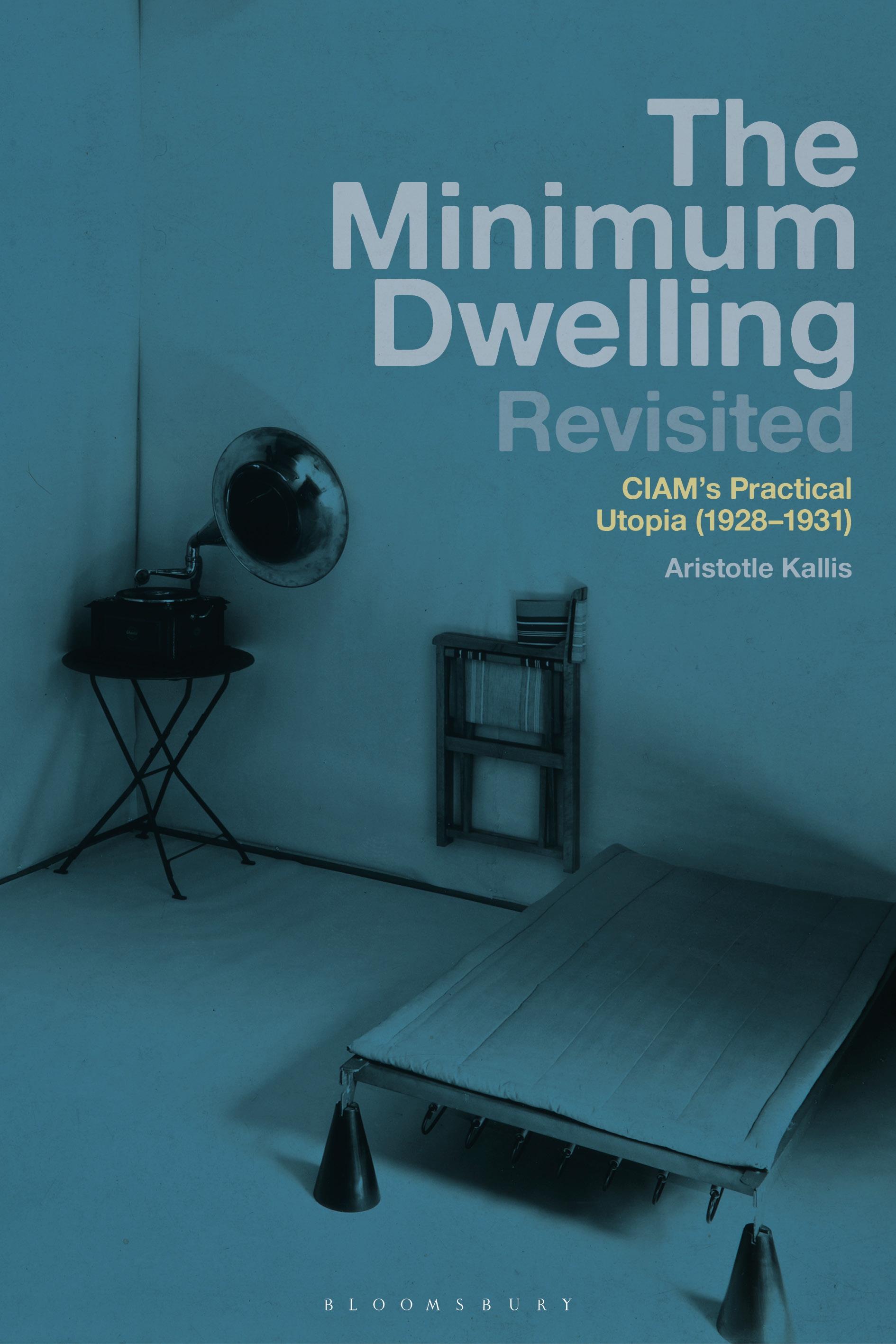
This book provides an intellectual history of the modernist "minimum dwelling", exploring how early modernism saw mass housing as a primary vehicle for achieving the utopian transformation of society. It reappraises the often-overlooked 2nd and 3rd CIAM conferences (1929-31), addressing their engagement with the "minimum dwelling" and revealing them both as milestones in the organisation's annals and as seminal moments in the history of interwar modernism.
In 1929, an eclectic international group of avant-garde modernist architects, including Ernst May, Mart Stam, Walter Gropius and Le Corbusier, met in Frankfurt for the second instalment of the CIAM conferences. They discussed a design programme for cost-effective, good-quality housing, seeking new approaches and processes to maximize quality and functionality while ensuring affordability for the wider population. In exploring the meaning and form of the 'minimum dwelling', they also re-defined dwelling as the hub of a new way of living, proposing a revolutionary multi-scalar approach to urban design based on the concept of the Existenzminimum ('optimally minimal housing').
Despite the two conferences falling short of the organizer's expectations, and being overshadowed by later instalments, the participating architects sanctioned a semantic shift from minimum as bare necessity to a very different, aspirational, kind of minimalism – transforming the entire conversation on mass low-cost dwelling in design, social and ethical terms.
Split into two parts, The Minimum Dwelling Revisited first takes a genealogical approach to explore the provenance of the concept of "minimum dwelling" prior to the 2nd and 3rd CIAM conferences, it then traces the proceedings of the two conferences themselves. Addressing the origins of the "minimum dwelling" concept but also its legacies, and serving as a corrective to the overemphasis on 4th CIAM conference and the Athens Charter, the book is essential reading for scholars researching urban design during the Interwar period.
In 1929, an eclectic international group of avant-garde modernist architects, including Ernst May, Mart Stam, Walter Gropius and Le Corbusier, met in Frankfurt for the second instalment of the CIAM conferences. They discussed a design programme for cost-effective, good-quality housing, seeking new approaches and processes to maximize quality and functionality while ensuring affordability for the wider population. In exploring the meaning and form of the 'minimum dwelling', they also re-defined dwelling as the hub of a new way of living, proposing a revolutionary multi-scalar approach to urban design based on the concept of the Existenzminimum ('optimally minimal housing').
Despite the two conferences falling short of the organizer's expectations, and being overshadowed by later instalments, the participating architects sanctioned a semantic shift from minimum as bare necessity to a very different, aspirational, kind of minimalism – transforming the entire conversation on mass low-cost dwelling in design, social and ethical terms.
Split into two parts, The Minimum Dwelling Revisited first takes a genealogical approach to explore the provenance of the concept of "minimum dwelling" prior to the 2nd and 3rd CIAM conferences, it then traces the proceedings of the two conferences themselves. Addressing the origins of the "minimum dwelling" concept but also its legacies, and serving as a corrective to the overemphasis on 4th CIAM conference and the Athens Charter, the book is essential reading for scholars researching urban design during the Interwar period.
Pay easily by card, Klarna, Apple Pay or Google Pay. Not happy? You always have a 14-day money-back guarantee. Read more in our terms. If you have any questions, email us at hello@memmo.org.
Memmo makes studying easier – wherever you are in the world. We bring your course books and smart study tools together in one place: summaries, quizzes, podcasts and flashcards. Plus Ted, your study buddy who answers anything you wonder. Over 75,000 students already study here – built to help you learn faster and stress less.