
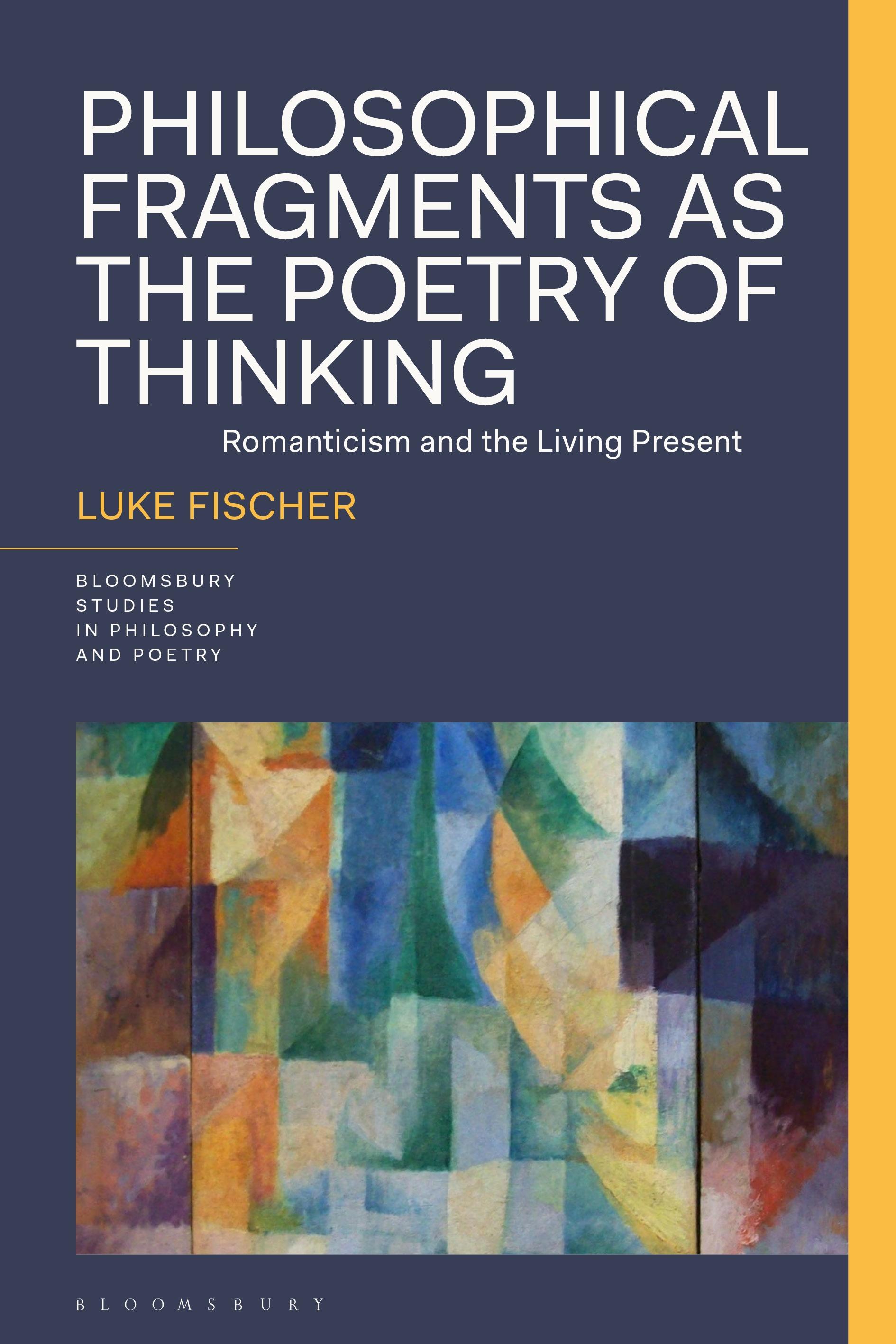
Innovatively combining philosophical inquiry and aphoristic writing, this study presents a bold new interpretation of philosophical poetics. Exploring fragments, both thematically and formally, Luke Fischer situates the form as uniquely positioned between philosophy and poetry.
Like poetry, fragments condense insights into few words, employ striking metaphors that draw intuitive connections, and make space for creative interpretation. Contrasting with the logical linearity of much philosophy, fragments disclose rather than prove, intimate more than argue, suggest a whole without elaborating a system, and emphasize the intuitive act of thinking. Fischer readjusts our understanding of philosophical ideas as they originate in moments of illumination, and reveals the fragment as philosophy in process. In a collection of original fragments and an exploratory essay, Fischer sheds light on the relation between poetry and philosophy, aesthetics and society, art and the environment, and discusses seminal practitioners of the fragmentary form, including Novalis, F. Schlegel, Nietzsche and Heraclitus. Philosophical Fragments as the Poetry of Thinking makes an engaging, nonlinear case for the possibility and significance of a poetic transmutation of philosophy.
Like poetry, fragments condense insights into few words, employ striking metaphors that draw intuitive connections, and make space for creative interpretation. Contrasting with the logical linearity of much philosophy, fragments disclose rather than prove, intimate more than argue, suggest a whole without elaborating a system, and emphasize the intuitive act of thinking. Fischer readjusts our understanding of philosophical ideas as they originate in moments of illumination, and reveals the fragment as philosophy in process. In a collection of original fragments and an exploratory essay, Fischer sheds light on the relation between poetry and philosophy, aesthetics and society, art and the environment, and discusses seminal practitioners of the fragmentary form, including Novalis, F. Schlegel, Nietzsche and Heraclitus. Philosophical Fragments as the Poetry of Thinking makes an engaging, nonlinear case for the possibility and significance of a poetic transmutation of philosophy.
Pay easily by card, Klarna, Apple Pay or Google Pay. Not happy? You always have a 14-day money-back guarantee. Read more in our terms. If you have any questions, email us at hello@memmo.org.
Memmo makes studying easier – wherever you are in the world. We bring your course books and smart study tools together in one place: summaries, quizzes, podcasts and flashcards. Plus Ted, your study buddy who answers anything you wonder. Over 50,000 students already study here – built to help you learn faster and stress less.