
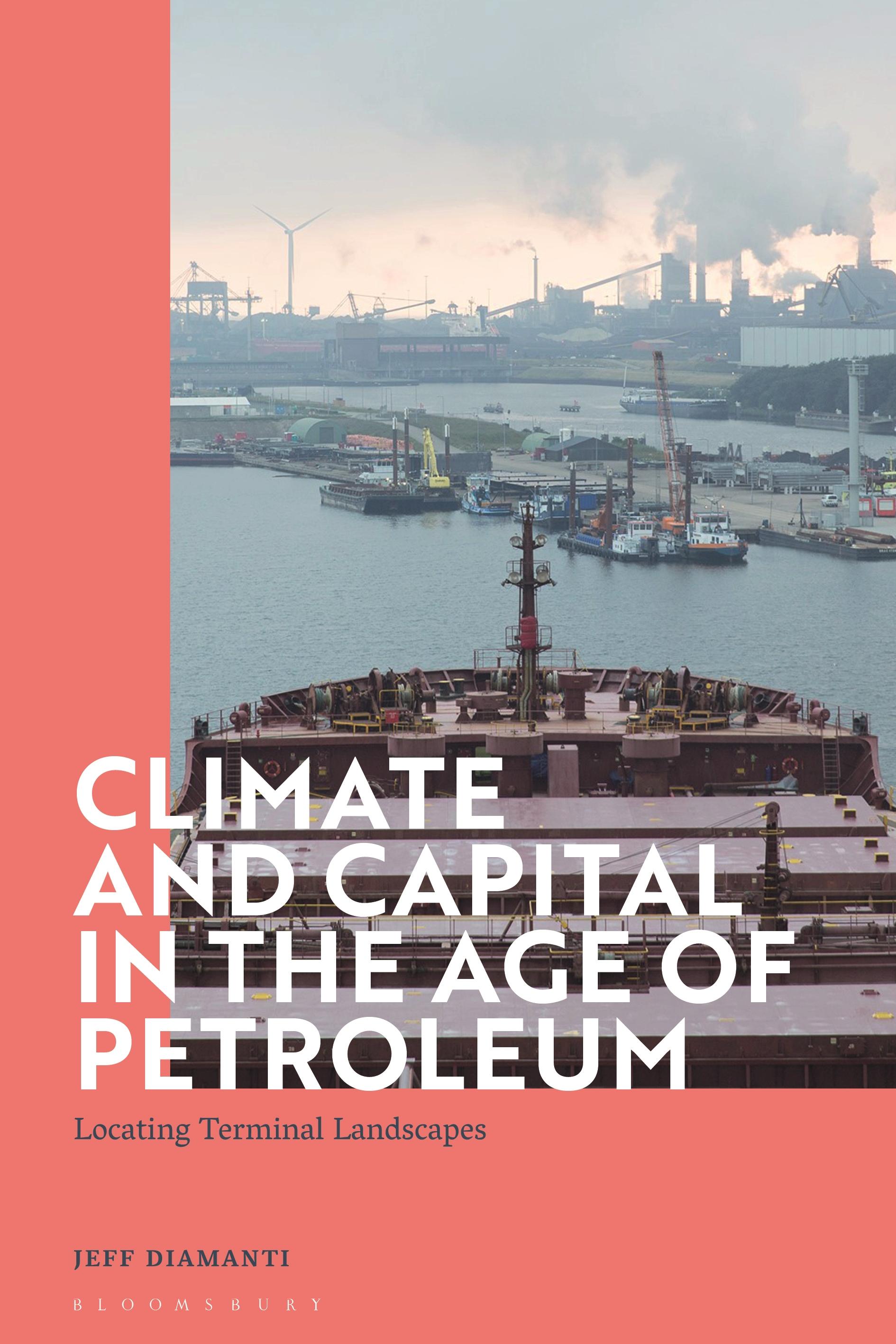
Jeff Diamanti describes the destructive relationship between climate and capital through the exponential growth of the petroleum industry over the last 40 years. Building on key insights in the environmental and energy humanities, Diamanti introduces the concept of the 'terminal landscape' as a site of storage, transformation and transition, essential to critical ecology in the 21st century.
Climate and Capital in the Age of Petroleum presents these scenes of transformation as sites through which post-industrial capitalism distributes fossil fuels into the world. Diamanti uses this concept to redefine the post-industrial landscape by revealing the global flows of exchange and storage that precede the distribution of fossil fuels into the world as social form. Advancing a new media theory of energy, fossil fuels and other finite resources become new types of distributable media. Through this line of thinking, the book makes solid connections between media technologies and energy cultures that help to shape a radical critique of the current energy infrastructure that characterises global capitalism.
Arguing that this infrastructure rests on millennia of compact matter, centuries of colonial violence, and decades of technological development, Diamanti's analysis deepens our understanding of the environment as a 'terminal landscape' through case studies of oil companies, countries, artworks, and historical events. Using his under-examined typology of global energy further theorises and politicises the climate crisis for scholars and activists alike.
Climate and Capital in the Age of Petroleum presents these scenes of transformation as sites through which post-industrial capitalism distributes fossil fuels into the world. Diamanti uses this concept to redefine the post-industrial landscape by revealing the global flows of exchange and storage that precede the distribution of fossil fuels into the world as social form. Advancing a new media theory of energy, fossil fuels and other finite resources become new types of distributable media. Through this line of thinking, the book makes solid connections between media technologies and energy cultures that help to shape a radical critique of the current energy infrastructure that characterises global capitalism.
Arguing that this infrastructure rests on millennia of compact matter, centuries of colonial violence, and decades of technological development, Diamanti's analysis deepens our understanding of the environment as a 'terminal landscape' through case studies of oil companies, countries, artworks, and historical events. Using his under-examined typology of global energy further theorises and politicises the climate crisis for scholars and activists alike.
Pages: 184
Category: Miljövetenskap & Klimat
e-ISBN: 9781350191853
Shipping weight: 1.2 kg
Ships in: 1-2 days
Pay easily by card, Klarna, Apple Pay or Google Pay. Not happy? You always have a 14-day money-back guarantee. Read more in our terms. If you have any questions, email us at hello@memmo.org.
Memmo makes studying easier – wherever you are in the world. We bring your course books and smart study tools together in one place: summaries, quizzes, podcasts and flashcards. Plus Ted, your study buddy who answers anything you wonder. Over 50,000 students already study here – built to help you learn faster and stress less.