
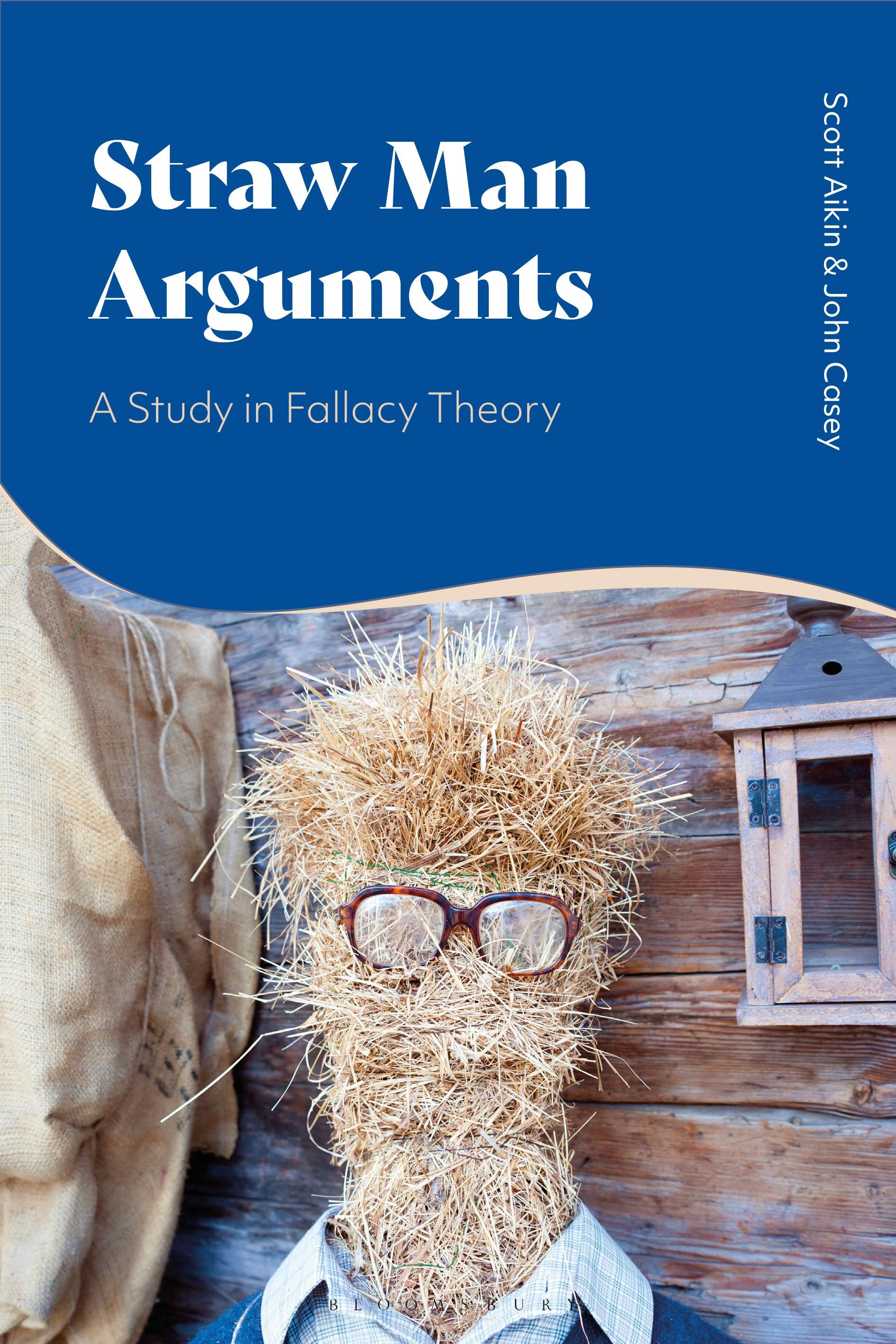
This book analyses the straw man fallacy and its deployment in philosophical reasoning. While commonly invoked in both academic dialogue and public discourse, it has not until now received the attention it deserves as a rhetorical device.
Scott Aikin and John Casey propose that straw manning essentially consists in expressing distorted representations of one's critical interlocutor. To this end, the straw man comprises three dialectical forms, and not only the one that is usually suggested: the straw man, the weak man and the hollow man. Moreover, they demonstrate that straw manning is unique among fallacies as it has no particular logical form in itself, because it is an instance of inappropriate meta-argument, or argument about arguments. They discuss the importance of the onlooking audience to the successful deployment of the straw man, reasoning that the existence of an audience complicates the dialectical boundaries of argument.
Providing a lively, provocative and thorough analysis of the straw man fallacy, this book will appeal to postgraduates and researchers alike, working in a range of fields including fallacies, rhetoric, argumentation theory and informal logic.
Scott Aikin and John Casey propose that straw manning essentially consists in expressing distorted representations of one's critical interlocutor. To this end, the straw man comprises three dialectical forms, and not only the one that is usually suggested: the straw man, the weak man and the hollow man. Moreover, they demonstrate that straw manning is unique among fallacies as it has no particular logical form in itself, because it is an instance of inappropriate meta-argument, or argument about arguments. They discuss the importance of the onlooking audience to the successful deployment of the straw man, reasoning that the existence of an audience complicates the dialectical boundaries of argument.
Providing a lively, provocative and thorough analysis of the straw man fallacy, this book will appeal to postgraduates and researchers alike, working in a range of fields including fallacies, rhetoric, argumentation theory and informal logic.
Pay easily by card, Klarna, Apple Pay or Google Pay. Not happy? You always have a 14-day money-back guarantee. Read more in our terms. If you have any questions, email us at hello@memmo.org.
Memmo makes studying easier – wherever you are in the world. We bring your course books and smart study tools together in one place: summaries, quizzes, podcasts and flashcards. Plus Ted, your study buddy who answers anything you wonder. Over 50,000 students already study here – built to help you learn faster and stress less.