
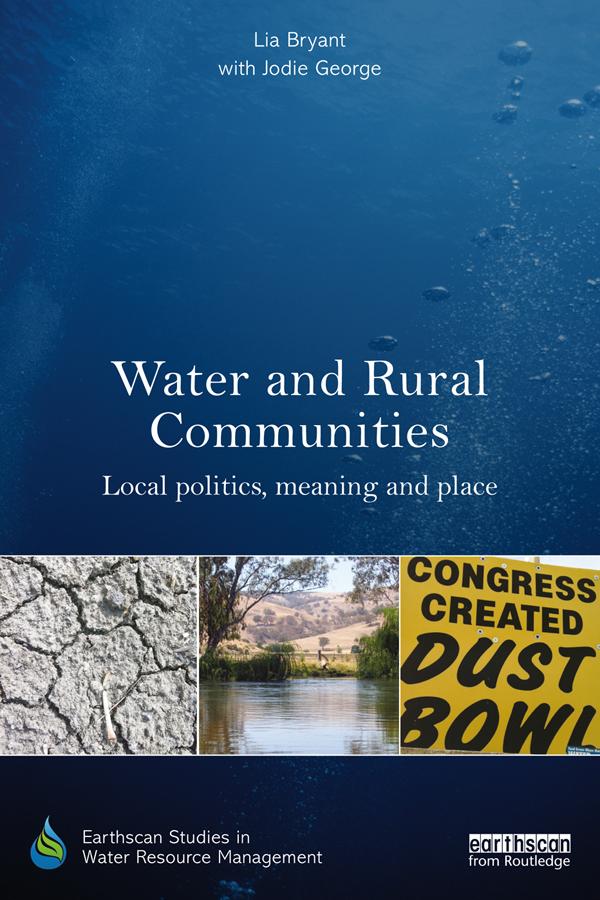
The overall theme of this book concerns the multiplicity and complexities of discursive constructions of water in Western economies in relation to irrigation communities. The authors argue that the politics of place is given meaning in relation to local knowledges and within multiple and multiscalar institutional frameworks involved with the social, physical, economic and political practices associated with water. They are particularly concerned with water at the local level, including how it is exchanged, managed and given meaning.
Using case studies from Australia and the United States of America, it is shown how water use and community relations, particularly during times of drought, are central to developing understandings about how communities challenge, adapt and respond to policy developments. The book also brings to light how unequal distribution of resources and risk conspicuously come to the surface during times of drought illustrating that water is a political subject occupying a unique position, moving between the natural and social worlds.
Pay easily by card, Klarna, Apple Pay or Google Pay. Not happy? You always have a 14-day money-back guarantee. Read more in our terms. If you have any questions, email us at hello@memmo.org.
Memmo makes studying easier – wherever you are in the world. We bring your course books and smart study tools together in one place: summaries, quizzes, podcasts and flashcards. Plus Ted, your study buddy who answers anything you wonder. Over 50,000 students already study here – built to help you learn faster and stress less.