
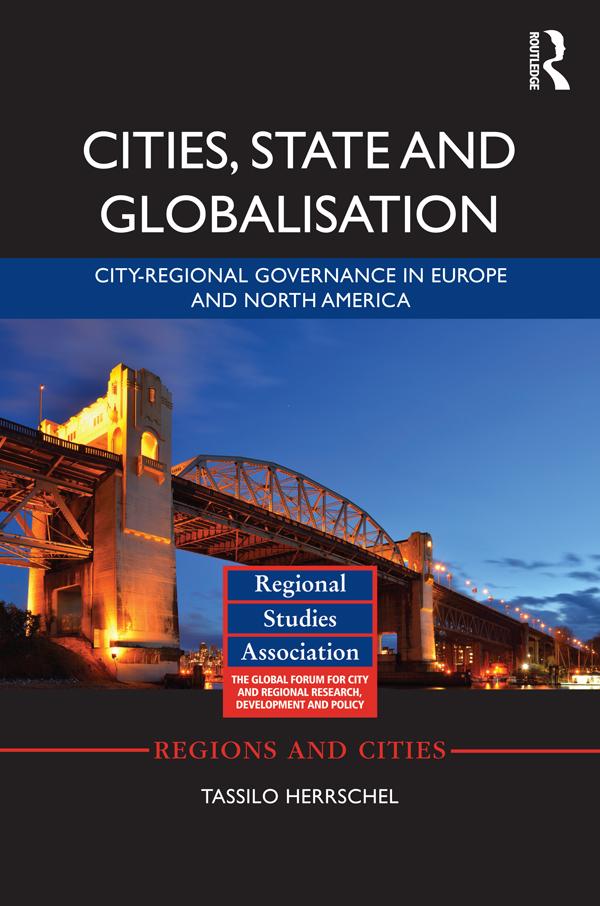
This book investigates the ways in which city regions view themselves as single entities, how they are governed, what is meant by ‘governance’, why the question of city-regional governance matters, and the extent to which the balance between internal and external factors is important for finding governance solutions. Examples from North America and Europe are compared and contrasted to gain a better understanding of what matters ‘on the ground’ to people and policy makers when seeking answers to the challenges of a globalised, rapidly changing world.
In order to analyse the conditions involved in making local decisions, the author looks at the impact of established policy-making practices, socio-economic patterns among the population, existing views of the ‘local’ and the ‘regional’ and their respective roles among the electorate and policy makers, and the scope for building city-regional governance under given statutory and fiscal provisions. The complex interaction of these factors is shown to produce place-specific forms and modi operandi for governing city regions as local-regional constructs.
This book will be of interest to urban and regional policy makers and scholars working in the fields of economic geography and political geography.
Pay easily by card, Klarna, Apple Pay or Google Pay. Not happy? You always have a 14-day money-back guarantee. Read more in our terms. If you have any questions, email us at hello@memmo.org.
Memmo makes studying easier – wherever you are in the world. We bring your course books and smart study tools together in one place: summaries, quizzes, podcasts and flashcards. Plus Ted, your study buddy who answers anything you wonder. Over 75,000 students already study here – built to help you learn faster and stress less.