
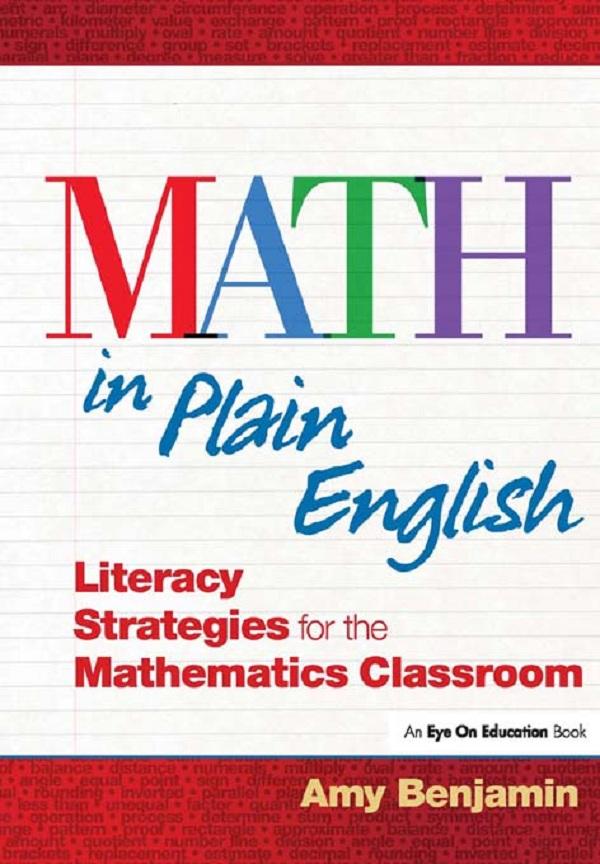
Do word problems and math vocabulary confuse students in your mathematics classes? Do simple keywords like "value" and "portion" seem to mislead them?
Many words that students already know can have a different meaning in mathematics. To grasp that difference, students need to connect English literacy skills to math. Successful students speak, read, write, and listen to each other so they can understand, retain, and apply mathematics concepts.
This book explains how to use 10 classroom-ready literacy strategies in concert with your mathematics instruction. You’ll learn how to develop students who are able to explain to themselves - and communicate to others - what problems mean and how to attack them.
Embedding these strategies in your instruction will help your students gain the literacy skills required to achieve the eight Common Core State Standards for Mathematics. You’ll discover the best answer to their question, "When am I ever going to use this?"
The 10 Strategies:
1. Teaching mathematical words explicitly
2. Teaching academic words implicitly
3. Reinforcing reading comprehension skills that apply to mathematics
4. Teaching mathematics with metaphor and gesture
5. Unlocking the meaning of word problems
6. Teaching note-taking skills for mathematics
7. Using language-based formative assessment in mathematics
8. Connecting memorization to meaning in mathematics
9. Incorporating writing-to-learn activities in mathematics
10. Preparing students for algebraic thinking
Pay easily by card, Klarna, Apple Pay or Google Pay. Not happy? You always have a 14-day money-back guarantee. Read more in our terms. If you have any questions, email us at hello@memmo.org.
Memmo makes studying easier – wherever you are in the world. We bring your course books and smart study tools together in one place: summaries, quizzes, podcasts and flashcards. Plus Ted, your study buddy who answers anything you wonder. Over 50,000 students already study here – built to help you learn faster and stress less.