
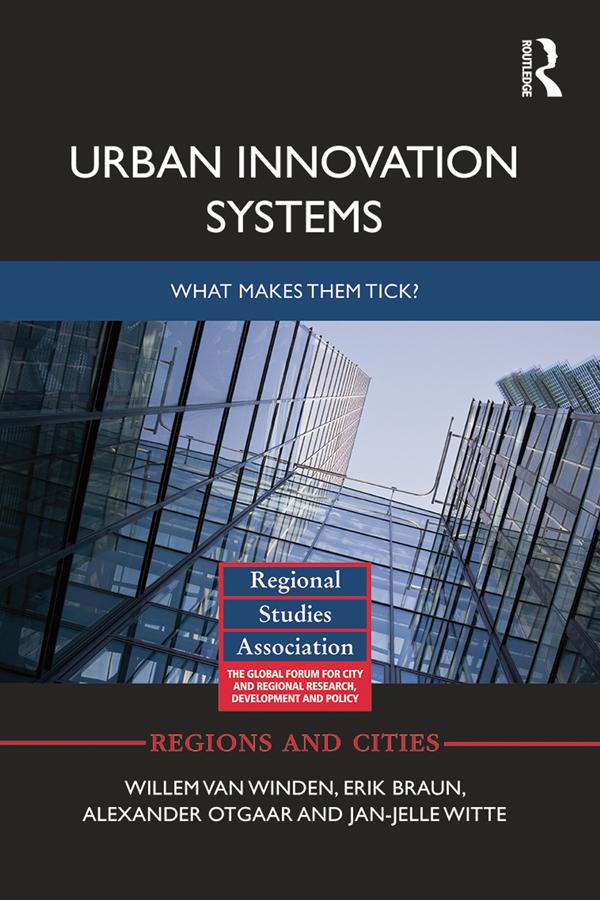
Why are some regions and cities so good at attracting talented people, creating high-level knowledge, and producing exciting new ideas and innovations? What are the ingredients of success? Can innovative cities be created and stimulated, or do they just flourish by mere chance? This book analyses the development and management of innovation systems in cities, in order to provide a better understanding of what makes such systems perform.
The book opens by developing a conceptual model that combines insights from urban economics with economic geography, urban governance and place marketing. This highlights the relevance of path dependence, different types of proximity (and the role of clusters, networks and platforms), institutional conditions, place attractiveness and place identity in the evolution of local innovation systems. The authors then draw on this conceptual framework to structure empirical case studies in three cities with a relatively high innovation performance: Eindhoven (the Netherlands), Stockholm (Sweden) and Suzhou (China). Through these case studies they provide a detailed analysis of how successful innovation systems evolve and what makes them tick.
Unique to this book is the linking of analysis to concrete policy and management responses. The book ends with a discussion on six themes in the development of successful urban innovation systems: firm-capabilities and leader firms, higher education and research, attractive environment, place branding, institutional environment and entrepreneurship. Each theme is examined fully, drawing lessons from the case studies, and from recent insights and other cases discussed in the literature.
This title will be of interest to students, researchers and policymakers involved in regional innovation systems, knowledge locations and cluster development.
Pay easily by card, Klarna, Apple Pay or Google Pay. Not happy? You always have a 14-day money-back guarantee. Read more in our terms. If you have any questions, email us at hello@memmo.org.
Memmo makes studying easier – wherever you are in the world. We bring your course books and smart study tools together in one place: summaries, quizzes, podcasts and flashcards. Plus Ted, your study buddy who answers anything you wonder. Over 75,000 students already study here – built to help you learn faster and stress less.