
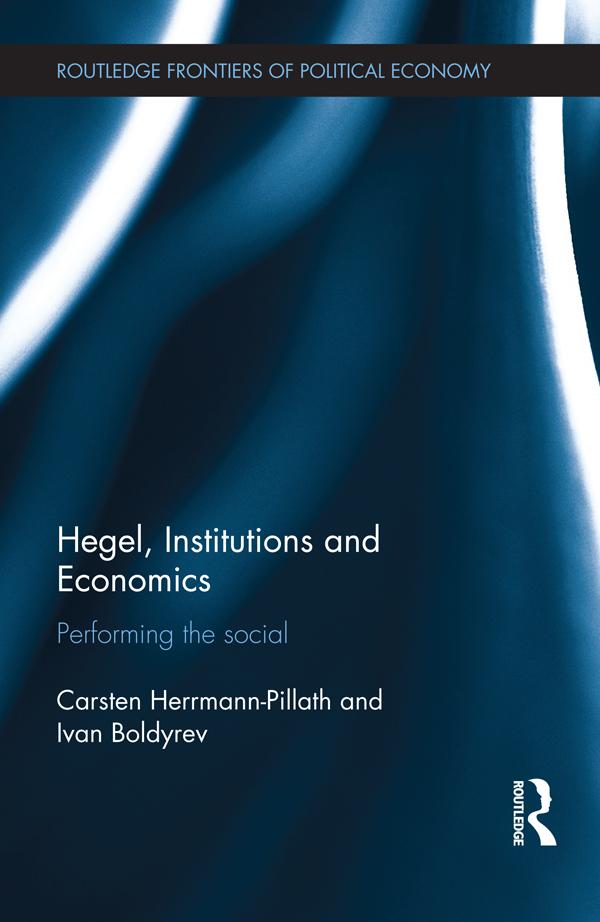
Hegel’s philosophy has witnessed periods of revival and oblivion, at times considered to be an unrivalled and all-embracing system of thought, but often renounced with no less ardour. This book renews the dialogue with Hegel by looking at his legacy as a source of insight and judgement that helps us rethink contemporary economics. This book focuses on a concept of institution which is equally important for Hegel's political philosophy and for economic theory to date.
The key contributions of this Hegelian perspective on economics lead us to the synthesis of traditional approaches and new ideas gained in economic experiments and advanced by neuroeconomists, sociologists and cognitive scientists. The proper account of contemporary 'civil society' involves comprehending it as a historically evolving totality of individual minds, ideas and intersubjective structures that are mutually dependent, tied by recognitive relations, and assert themselves as a whole in the ongoing performative movement of 'objective spitit'. The ethics of recognition is paired with the ethics of associations that supports moral principles and gives them true, concrete universality.
This unusual constellation of seemingly remote fields suggests that Hegel, read in a pragmatist mode, anticipated the new theories and philosophies of extended mind, social cognition and performativity. By providing a new conceptual apparatus and reformulating the theory of institutions in the light of this new synthesis, this book claims to give new meaning both to Hegel as interpreted from today, and to the social sciences. Seen from this perspective, such phenomena as cooperation in games, personal identity or justice in the version of Amartya Sen's 'realization-focused comparisons' are reinscribed into the logic of institutional theory. This 'Hegel' clearly goes beyond the limits of philosophical discussion and becomes a decisive reference for economists, sociologists, political scientists and other scholars who study the foundations and consequences of human sociality and try to explore and design the institutions necessary for a worthy common life.
Pay easily by card, Klarna, Apple Pay or Google Pay. Not happy? You always have a 14-day money-back guarantee. Read more in our terms. If you have any questions, email us at hello@memmo.org.
Memmo makes studying easier – wherever you are in the world. We bring your course books and smart study tools together in one place: summaries, quizzes, podcasts and flashcards. Plus Ted, your study buddy who answers anything you wonder. Over 50,000 students already study here – built to help you learn faster and stress less.