
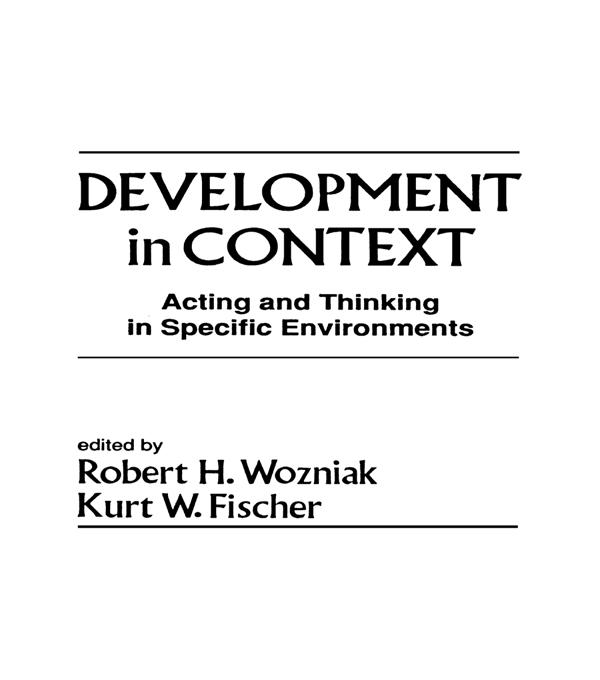
In this volume leading developmentalists address the question of how children's thinking develops in context by drawing on the theories of Vygotsky, Gibson, and Piaget.
Analyses of the ecology and the dynamics of behavior have become popular, emphasizing the particulars of people acting in specific environments and the many complex factors of human body and mind that contribute to action and thought. This volume brings together many of the current efforts to deal with development in this richly ecological, dynamic way.
The research reported demonstrates that recent years have produced major shifts in approach. Activities are studied as they naturally occur in everyday contexts. Children's active construction of the world around them is treated as fundamentally social in nature, occurring in families, with peers, and in cultures. Behavior is studied not as something disembodied but within a rich matrix of body, emotion, belief, value, and physical world. Behavior is analyzed as changing dynamically, not only over seconds and minutes, but over hours, days, and years.
Pay easily by card, Klarna, Apple Pay or Google Pay. Not happy? You always have a 14-day money-back guarantee. Read more in our terms. If you have any questions, email us at hello@memmo.org.
Memmo makes studying easier – wherever you are in the world. We bring your course books and smart study tools together in one place: summaries, quizzes, podcasts and flashcards. Plus Ted, your study buddy who answers anything you wonder. Over 50,000 students already study here – built to help you learn faster and stress less.