
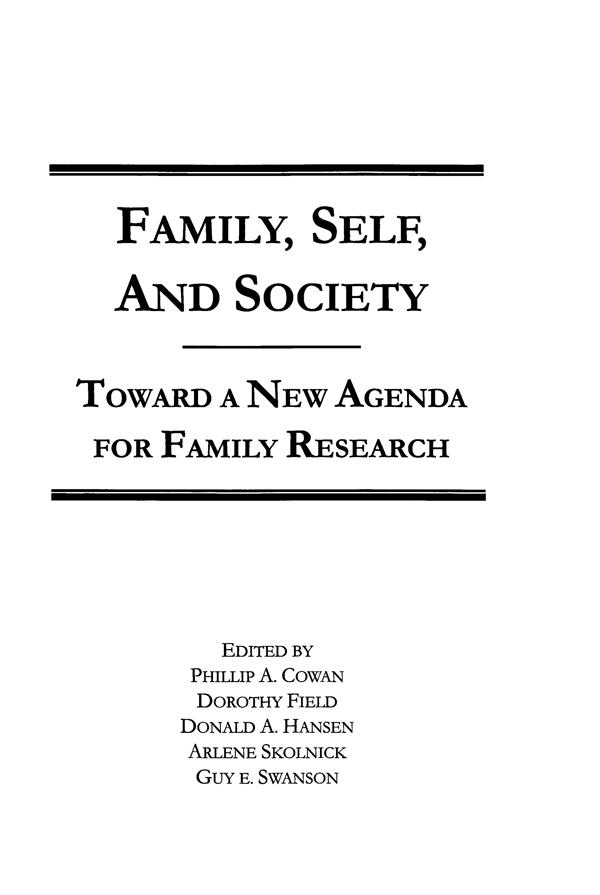
Any agenda for family research in the 1990s must take seriously a contextual approach to the study of family relationships. The editors and contributors to this volume believe that the richness in family studies over the next decade will come from considering the diversity of family forms -- different ethnic groups and cultures, different stages of family life, as well as different historical cohorts. Their goal is to make more explicit how we think about families in order to study them and understand them. To illustrate the need for diversity in family studies, examples are presented from new and old families, majority and minority families, American and Japanese families, and intact and divorcing families. This variety is intended to push the limits of current thinking, not only for researchers but also for all who are struggling to live with and work with families in a time when family life is valued but fragmented and relatively unsupported by society's institutions. Students and researchers interested in family development from the viewpoint of any of the social sciences will find this book of value.
Pay easily by card, Klarna, Apple Pay or Google Pay. Not happy? You always have a 14-day money-back guarantee. Read more in our terms. If you have any questions, email us at hello@memmo.org.
Memmo makes studying easier – wherever you are in the world. We bring your course books and smart study tools together in one place: summaries, quizzes, podcasts and flashcards. Plus Ted, your study buddy who answers anything you wonder. Over 50,000 students already study here – built to help you learn faster and stress less.