
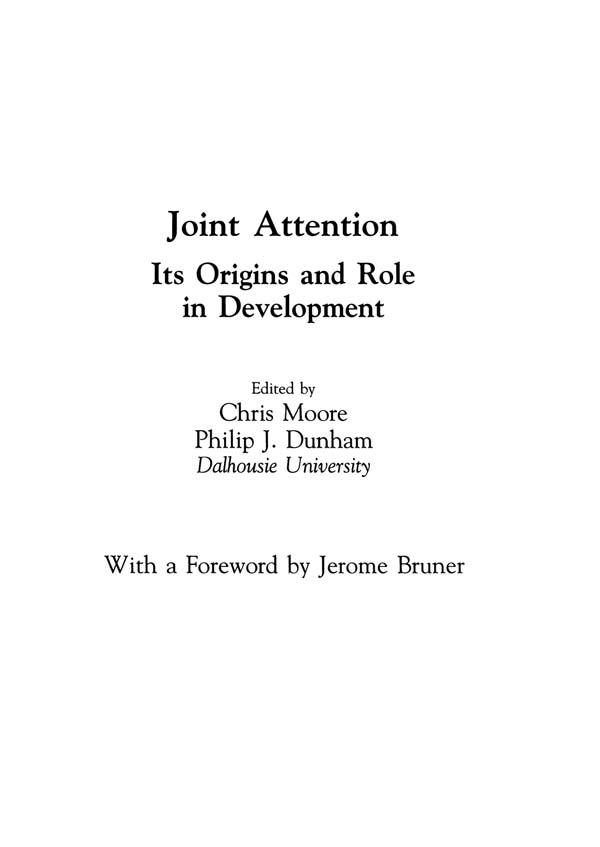
It is perhaps no exaggeration to suggest that all of what is intrinsically human experience is grounded in its shared nature. Joint attention to objects and events in the world provides the initial means whereby infants can start to share experiences with others and negotiate shared meanings. It provides a context for the development of both knowledge about the world and about others as experiencers. It plays a central role in the development of the young child's understanding of both the social and nonsocial worlds and in the development of the communicative interplay between child and adult. The first devoted to this important topic, this volume explores how joint attention first arises, its developmental course, its role in communication and social understanding, and the ways in which disruptions in joint attention may be implicated in a variety of forms of abnormal development including autism.
Pay easily by card, Klarna, Apple Pay or Google Pay. Not happy? You always have a 14-day money-back guarantee. Read more in our terms. If you have any questions, email us at hello@memmo.org.
Memmo makes studying easier – wherever you are in the world. We bring your course books and smart study tools together in one place: summaries, quizzes, podcasts and flashcards. Plus Ted, your study buddy who answers anything you wonder. Over 50,000 students already study here – built to help you learn faster and stress less.