
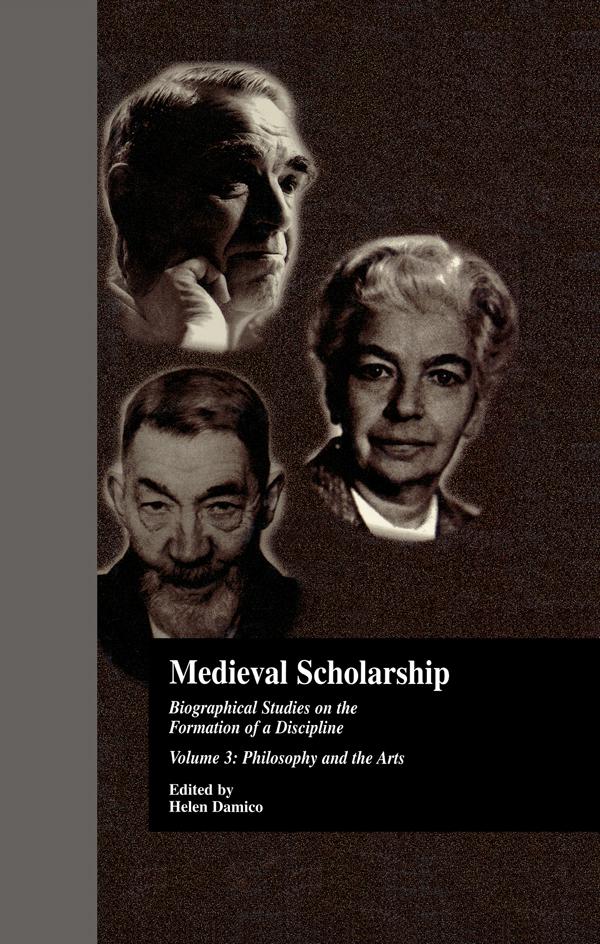
This is the third of a three-volume set on medieval scholarship that presents original biographical essays on scholars whose work has shaped medieval studies for the past four hundred years. A companion to Volume 1: History and Volume 2: Literature and Philology, Volume 3: Philosophy and the Arts covers the lives of twenty eminent individuals-from Victor Cousin (1792-1867) to Georges Chehata Anawati (1905-1994) in Philosophy; from H.J.W. Tillyard (1881-1968) to Gustave Reese (1899-1977) in Music; and from Alois Riegl (1858-1905) to Louis Grodecki (1910-1982) in Art History-whose subjects were the art, music, and philosophical thought of Europe between 500-1500. The scholars of medieval philosophy strove to identify the nexus of philosophical truth, whether they were engaged in the clash of the Christian church and secular republicanism as reflected in the tension between theology and philosophy, in addressing the conflicting perceptions of Muslim identity, or in defining Jewish philosophical theology in non-Jewish culture. Medieval musicologists, who are included as the subjects of the essays, pioneered or recontextualized traditional views on the definition of music as subject matter, on the relationship between music and philosophical concepts, on interpretative distinctions between secular and sacred music, monophony and polyphony, and concepts of form and compositional style. The art historians treated in this volume not only overturn the view of medieval art as an aesthetic decline from classical art, but they demonstrate the continual development of form and style inclusive of minor and major arts, in textiles, architecture and architectural sculpture, manuscripts, ivory carvings, and stained glass. The philosophers, musicologists, and art historians who appear in Volume 3 worked in three newly-emerging disciplines largely of nineteenth-century origin. In their distinguished and extraordinary output of energy in scholarly and academic arenas, they contributed significantly to the emergence and formation of medieval studies as the prime discipline of historical inquiry into and hence the key to understanding of the human experience.
Pay easily by card, Klarna, Apple Pay or Google Pay. Not happy? You always have a 14-day money-back guarantee. Read more in our terms. If you have any questions, email us at hello@memmo.org.
Memmo makes studying easier – wherever you are in the world. We bring your course books and smart study tools together in one place: summaries, quizzes, podcasts and flashcards. Plus Ted, your study buddy who answers anything you wonder. Over 50,000 students already study here – built to help you learn faster and stress less.
You might also like
Buy the book0