
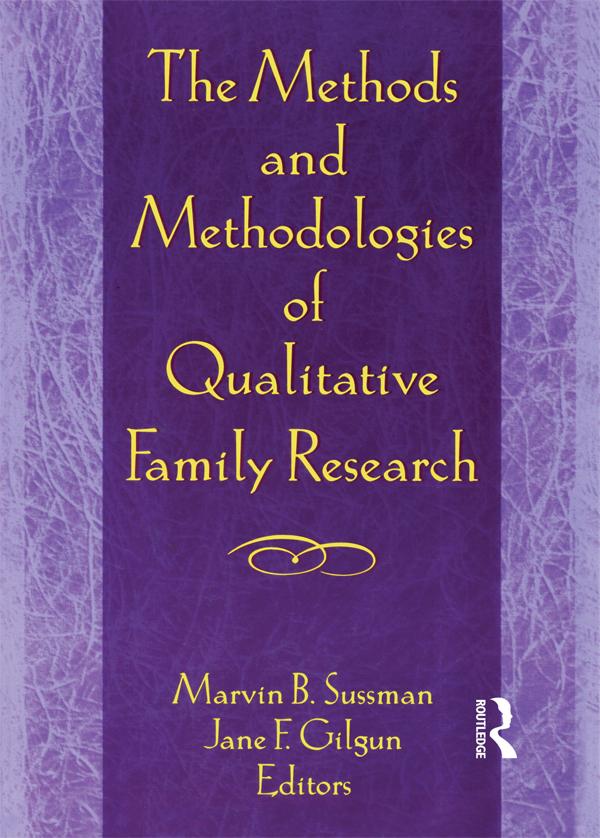
The Methods and Methodologies of Qualitative Family Research can provide you with a strong conceptual framework for undertaking qualitative research. As it explores inquiry and theory on the cutting edge, it shows how qualitative methodologies can be applied to family life, education, and research. Designed to demonstrate how emerging and established methodologies can advance the understanding of families and direct social change, this book is a major step in assessing the development, progress, and contributions of qualitative inquiry. Packed with useful information and innovative approaches, this volume pulls together a rich and diverse group of essays that teach readers about the complexities and challenges of qualitative research. Most importantly, you’ll learn how new qualitative approaches are grounded in systems thinking, holistic formulations, attention to context, cultural sensitivity, and nonlinear dynamics.The Methods and Methodologies of Qualitative Family Research is distinct from other books of its kind because it acknowledges the agent, or self, in compiling data and reaching conclusions. Moreover, it analyzes how studying the world affects those doing the studying and how those effects, in turn, play a substantial role in interpreting data and forming conclusions. The Methods and Methodologies of Qualitative Family Research introduces three major types of qualitative clinical family research: conversational analysis, recursive frame analysis, and hermeneutic phenomenology. It exposes a wide array of resources for undertaking qualitative inquiry, including data journals, letters, official files, clinical case notes, folk tales, interviews, and field observations. You’ll learn how these resources are invaluable tools for understanding:
- couples’decisionmaking
- generative fathering
- reflexivity
- the use of historical data to construct composite cases
- egalitarianism and oppression in marriage
- perceptions of gender, race, and class among African-American adolescent women
- successful aging among individuals who require long-term care
- poverty and access to servicesA skillful blend of theory and practice, The Methods and Methodologies of Qualitative Family Research offers conceptual schemes, bibliographies, and other useful resources for teaching and conducting qualitative research. It will revolutionize the way you think about qualitative inquiry and your own approaches to qualitative family research. In addition, you’ll come away updated on the current state of qualitative research and with new skills and techniques for tackling your own research.
Pay easily by card, Klarna, Apple Pay or Google Pay. Not happy? You always have a 14-day money-back guarantee. Read more in our terms. If you have any questions, email us at hello@memmo.org.
Memmo makes studying easier – wherever you are in the world. We bring your course books and smart study tools together in one place: summaries, quizzes, podcasts and flashcards. Plus Ted, your study buddy who answers anything you wonder. Over 50,000 students already study here – built to help you learn faster and stress less.