
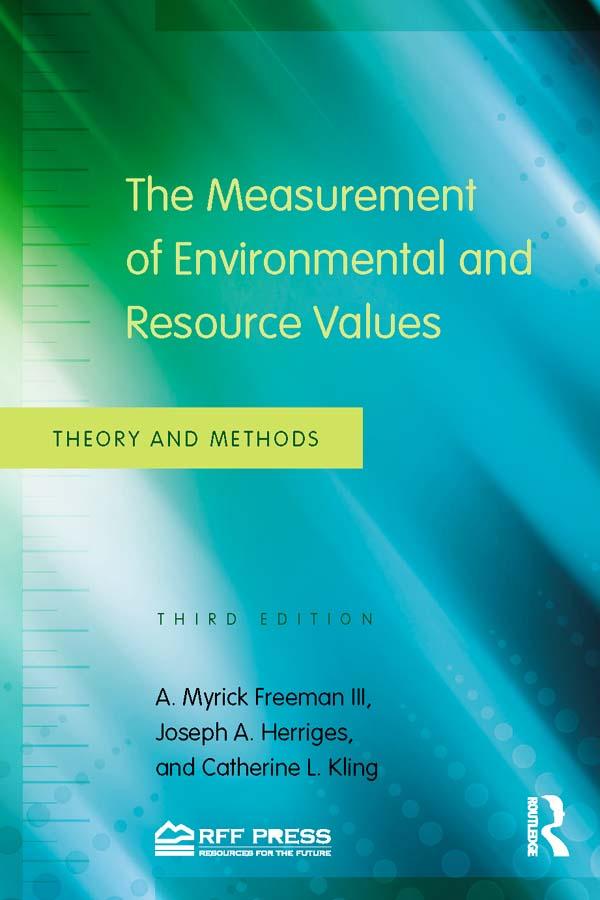
The first edition of this important work was the winner of the 2002 Publication of Enduring Quality award by the Association of Environmental and Resource Economists. The continuing premise for the book is that estimates of the economic values of environmental and natural resource services are essential for effective policy-making. As previous editions, the third edition, which includes two additional co-authors, presents a comprehensive treatment of the theory and methods involved in estimating environmental benefits.
Researchers, policy-makers, and practitioners will welcome the work as an up-to-date reference on recent developments. Students will gain a better understanding of the contribution that economics as a discipline can make to decisions concerning pollution control and human health, recreation, environmental amenities, and other critical issues concerning the way we use and interact with environmental and natural resource systems. To reflect recent progress in both the theory and practice of non-market valuation, the third edition includes more details on empirical approaches to measurement, expanded discussion of the reasons for divergence between "willingness to pay" and "willingness to accept compensation," and increased coverage of econometric issues encountered in estimation. In keeping with its cutting edge orientation, it also includes more discussion of survey design, equilibrium sorting models, and the implications of behavioral economics for welfare measurements and benefit cost analysis.
Pay easily by card, Klarna, Apple Pay or Google Pay. Not happy? You always have a 14-day money-back guarantee. Read more in our terms. If you have any questions, email us at hello@memmo.org.
Memmo makes studying easier – wherever you are in the world. We bring your course books and smart study tools together in one place: summaries, quizzes, podcasts and flashcards. Plus Ted, your study buddy who answers anything you wonder. Over 50,000 students already study here – built to help you learn faster and stress less.