
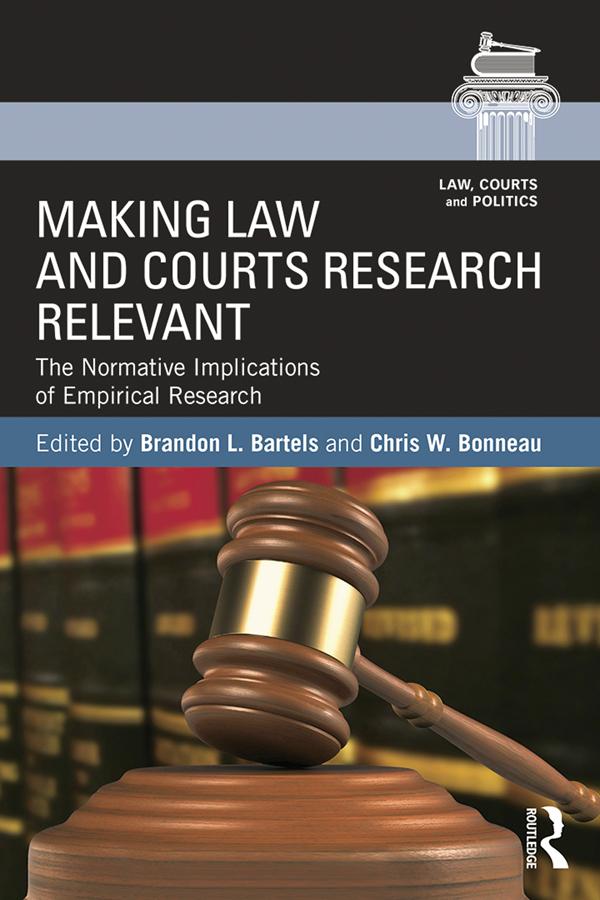
One of the more enduring topics of concern for empirically-oriented scholars of law and courts—and political scientists more generally—is how research can be more directly relevant to broader audiences outside of academia. A significant part of this issue goes back to a seeming disconnect between empirical and normative scholars of law and courts that has increased in recent years.
Brandon L. Bartels and Chris W. Bonneau argue that being attuned to the normative implications of one’s work enhances the quality of empirical work, not to mention makes it substantially more interesting to both academics and non-academic practitioners. Their book’s mission is to examine how the normative implications of empirical work in law and courts can be more visible and relevant to audiences beyond academia. Written by scholars of political science, law, and sociology, the chapters in the volume offer ideas on a methodology for communicating normative implications in a balanced, nuanced, and modest manner. The contributors argue that if empirical work is strongly suggestive of certain policy or institutional changes, scholars should make those implications known so that information can be diffused. The volume consists of four sections that respectively address the general enterprise of developing normative implications of empirical research, law and decisionmaking, judicial selection, and courts in the broader political and societal context.
This volume represents the start of a conversation on the topic of how the normative implications of empirical research in law and courts can be made more visible. This book will primarily interest scholars of law and courts, as well as students of judicial politics. Other subfields of political science engaging in empirical research will also find the suggestions made in the book relevant.
Pay easily by card, Klarna, Apple Pay or Google Pay. Not happy? You always have a 14-day money-back guarantee. Read more in our terms. If you have any questions, email us at hello@memmo.org.
Memmo makes studying easier – wherever you are in the world. We bring your course books and smart study tools together in one place: summaries, quizzes, podcasts and flashcards. Plus Ted, your study buddy who answers anything you wonder. Over 50,000 students already study here – built to help you learn faster and stress less.