
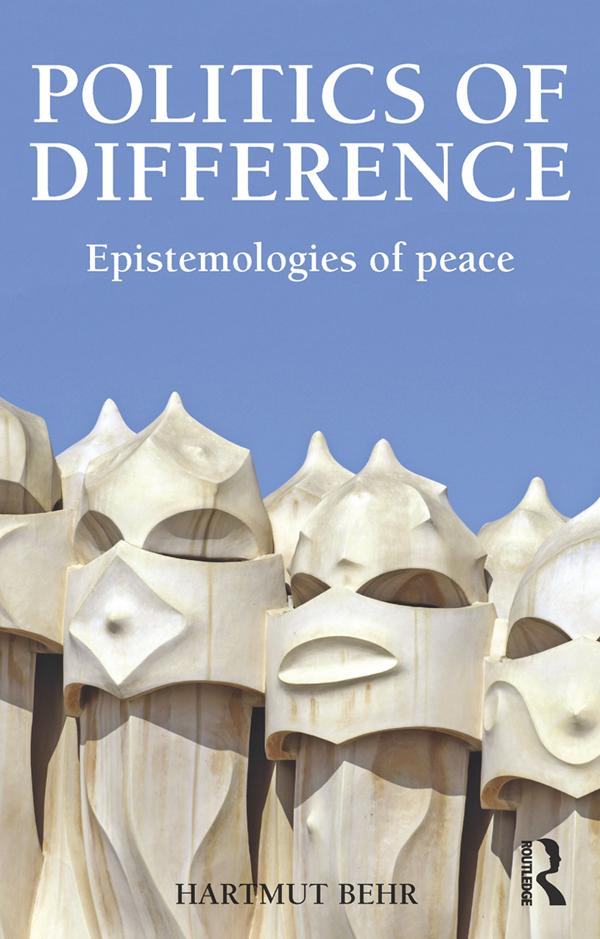
This book develops a notion of differences and 'otherness' beyond hegemonic and hierarchical thinking as represented by the legacies of Western philosophical and political thought.
In doing so, it relates to the phenomenological discourse of the twentieth century, especially to Georg Simmel, Alfred Schütz, Emmanual Lévinas, and Jacques Derrida, and drafts our understanding of difference as a genuine human experience of a social and political world that is in motion and transformative, rather than static and predictable. On this basis of temporalized ontology and its normative consequences, differences are drafted as a positive social and political force and as powerful capacities of transformation and change. In practical terms, this understanding is most important for our theorizing and acting upon peace, peace-building, and conflict solution. Differences now appear not as obstacle to peace and reconciliation, but as lively and constructive articulations of 'otherness' and as a positive power of transformation, emancipation, and change.
This book will be of interest to students of international relations, philosophy and political theory.
Pay easily by card, Klarna, Apple Pay or Google Pay. Not happy? You always have a 14-day money-back guarantee. Read more in our terms. If you have any questions, email us at hello@memmo.org.
Memmo makes studying easier – wherever you are in the world. We bring your course books and smart study tools together in one place: summaries, quizzes, podcasts and flashcards. Plus Ted, your study buddy who answers anything you wonder. Over 50,000 students already study here – built to help you learn faster and stress less.