
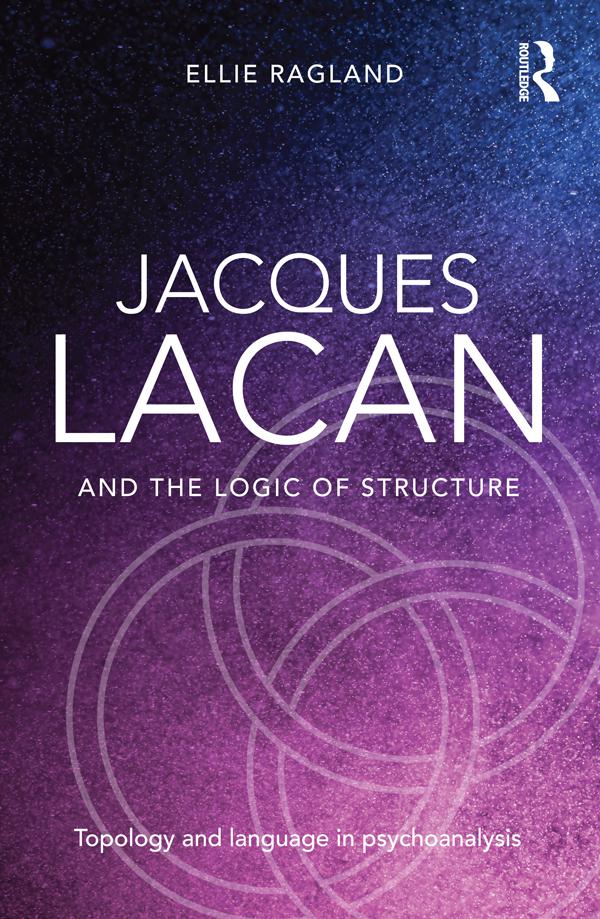
Lacan postulated that the psyche can be understood by means of certain structures, which control our lives and our desires, and which operate differently at different logical moments or stages of formation. Jacques Lacan and the Logic of Structure offers us a reading of the major concepts of Lacan in terms of his later topological theory and aims to show how this was always a concern for Lacan and not only an issue in the last seminars.
Ellie Ragland discusses how various stages of formation can be uncovered topologically within language itself, and operate to place certain properties – fantasy, the drive, jouissance, discourse and ethics in language itself. In this way she explores not only how language actually works in tandem with the properties, but also gives a different idea of what knowledge actually is and what implications that may have for reimagining and reworking differential/diagnostic structures.
Jacques Lacan and the Logic of Structure is a compelling exponent of the innovative approaches Lacan takes to rethinking what psychoanalysis is and what it can do to enlighten psychoanalysts and treat patients. It will be essential reading to psychoanalysts, psychoanalytic psychotherapists training graduate students in the fields of film, literary, gender and cultural studies.
Pay easily by card, Klarna, Apple Pay or Google Pay. Not happy? You always have a 14-day money-back guarantee. Read more in our terms. If you have any questions, email us at hello@memmo.org.
Memmo makes studying easier – wherever you are in the world. We bring your course books and smart study tools together in one place: summaries, quizzes, podcasts and flashcards. Plus Ted, your study buddy who answers anything you wonder. Over 50,000 students already study here – built to help you learn faster and stress less.