
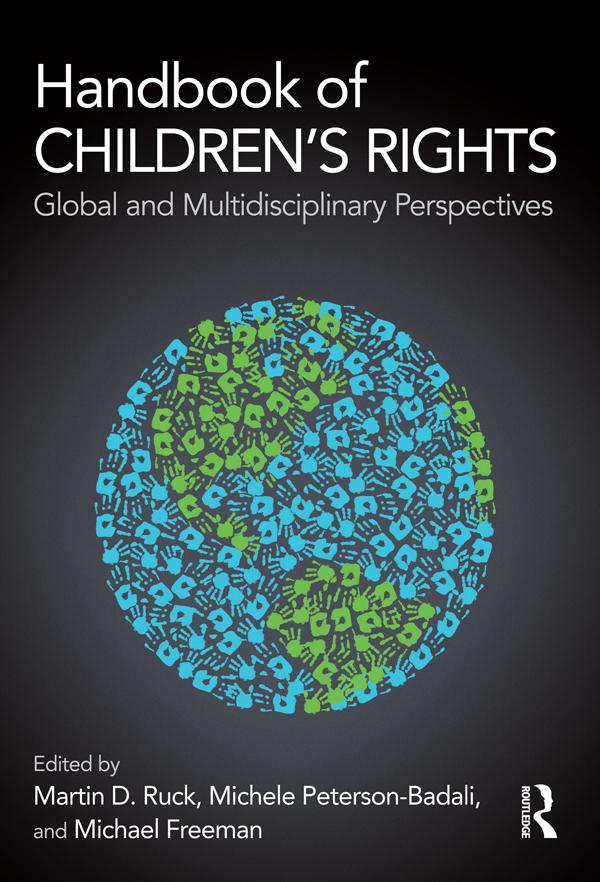
While the notion of young people as individuals worthy or capable of having rights is of relatively recent origin, over the past several decades there has been a substantial increase in both social and political commitment to children’s rights as well as a tendency to grant young people some of the rights that were typically accorded only to adults. In addition, there has been a noticeable shift in orientation from a focus on children’s protection and provision to an emphasis on children’s participation and self-determination.
With contributions from a wide range of international scholars, the Handbook of Children’s Rights brings together research, theory, and practice from diverse perspectives on children’s rights. This volume constitutes a comprehensive treatment of critical perspectives concerning children’s rights in their various forms. Its contributions address some of the major scholarly tensions and policy debates comprising the current discourse on children’s rights, including the best interests of the child, evolving capacities of the child, states’ rights versus children’s rights, rights of children versus parental or family rights, children as citizens, children’s rights versus children’s responsibilities, and balancing protection and participation. In addition to its multidisciplinary focus, the handbook includes perspectives from social science domains in which children’s rights scholarship has evolved largely independently due to distinct and seemingly competing assumptions and disciplinary approaches (e.g., childhood studies, developmental psychology, sociology of childhood, anthropology, and political science). The handbook also brings together diverse methodological approaches to the study of children’s rights, including both quantitative and qualitative perspectives, and policy analysis.
This comprehensive, cosmopolitan, and timely volume serves as an important reference for both scholarly and policy-driven interest in the voices and perspectives of children and youth.
Pay easily by card, Klarna, Apple Pay or Google Pay. Not happy? You always have a 14-day money-back guarantee. Read more in our terms. If you have any questions, email us at hello@memmo.org.
Memmo makes studying easier – wherever you are in the world. We bring your course books and smart study tools together in one place: summaries, quizzes, podcasts and flashcards. Plus Ted, your study buddy who answers anything you wonder. Over 50,000 students already study here – built to help you learn faster and stress less.