
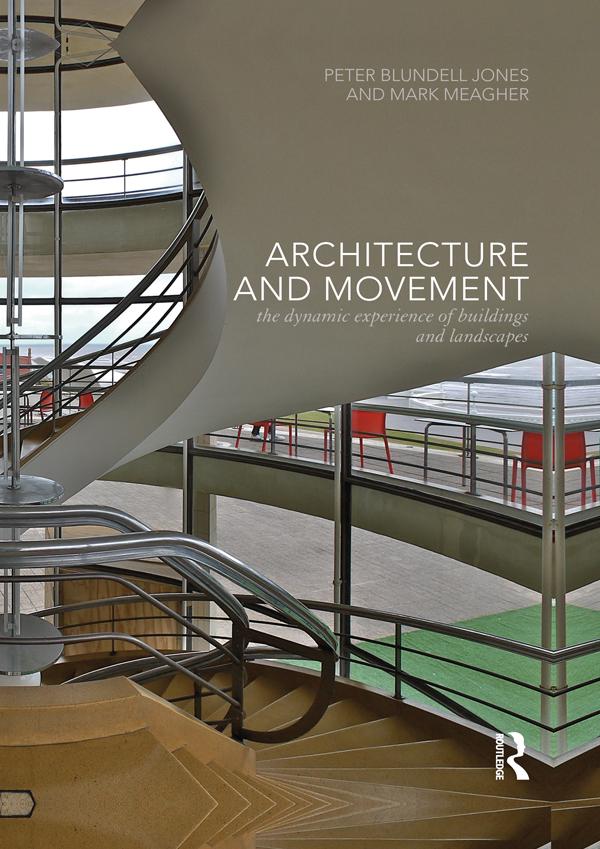
The experience of movement, of moving through buildings, cities, landscapes and in everyday life, is the only involvement most individuals have with the built environment on a daily basis. User experience is so often neglected in architectural study and practice. Architecture and Movement tackles this complex subject for the first time, providing the wide range of perspectives needed to tackle this multi-disciplinary topic.
Organised in four parts it:
- documents the architect’s, planner’s, or designer’s approach, looking at how they have sought to deploy buildings as a promenade and how they have thought or written about it
- concentrates on the individual’s experience, and particularly on the primacy of walking, which engages other senses besides the visual
- engages with society and social rituals, and how mutually we define the spaces through which we move, both by laying out routes and boundaries and by celebrating thresholds
- analyses how we deal with promenades which are not experienced directly but via other mediums such as computer models, drawings, film and television
The wide selection of contributors include academics and practitioners and discuss cases from across the US, UK, Europe and Asia. By mingling such disparate voices in a carefully curated selection of chapters, the book enlarges the understanding of architects, architectural students, designers and planners, alerting them to the many and complex issues involved in the experience of movement.
Pay easily by card, Klarna, Apple Pay or Google Pay. Not happy? You always have a 14-day money-back guarantee. Read more in our terms. If you have any questions, email us at hello@memmo.org.
Memmo makes studying easier – wherever you are in the world. We bring your course books and smart study tools together in one place: summaries, quizzes, podcasts and flashcards. Plus Ted, your study buddy who answers anything you wonder. Over 75,000 students already study here – built to help you learn faster and stress less.