
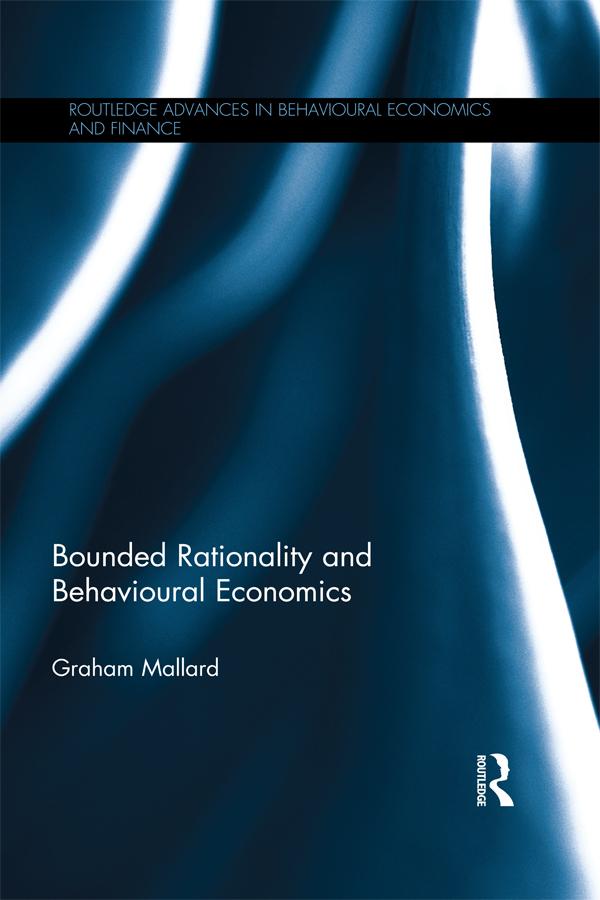
Economics Nobel Laureate Herbert Simon developed the concept of bounded rationality in the 1950s. This asserts that the cognitive abilities of human decision-makers are not always sufficient to find optimal solutions to complex real-life problems, leading decision-makers to find satisfactory, sub-optimal outcomes. This was a foundational component of the development of Behavioural Economics but in recent years the two fields have diverged, each with its own literature, its own approach and its own proponents. Behavioural Economics explores the areas of commonality between Economics and Psychology, in terms of its focus and its approach, whereas the bounded rationality literature largely analyses the implications of sub-optimal decision‐making through the mathematically sophisticated methodology of mainstream Economics.
This book examines the nature and consequences of this divergence and questions whether this is a case of beneficial specialisation or whether it is unhelpful, potentially stunting the development of some aspects of Economics. It has been suggested that the major deficiency of Behavioural Economics is that it has failed to produce a single, widely applicable alternative to constrained optimisation. This book evaluates the extent to which this is the true and, if it is, the extent to which it is a product of the divergence between the two literatures. It also seeks to identify commonalities between the two subjects and suggests avenues of research in Economics that would benefit from a re-fusion of these two fields.
Pay easily by card, Klarna, Apple Pay or Google Pay. Not happy? You always have a 14-day money-back guarantee. Read more in our terms. If you have any questions, email us at hello@memmo.org.
Memmo makes studying easier – wherever you are in the world. We bring your course books and smart study tools together in one place: summaries, quizzes, podcasts and flashcards. Plus Ted, your study buddy who answers anything you wonder. Over 50,000 students already study here – built to help you learn faster and stress less.