
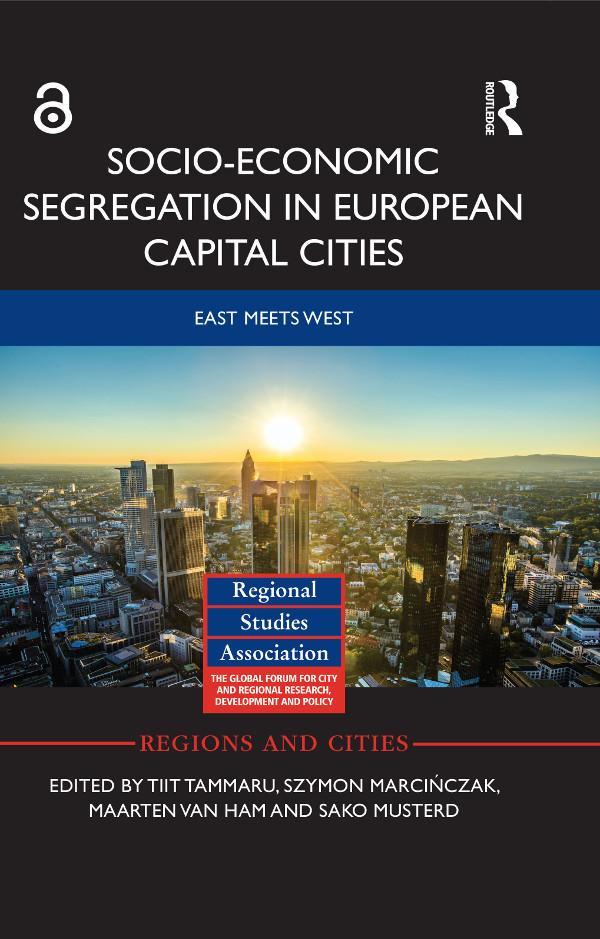
Growing inequalities in Europe are a major challenge threatening the sustainability of urban communities and the competiveness of European cities. While the levels of socio-economic segregation in European cities are still modest compared to some parts of the world, the poor are increasingly concentrating spatially within capital cities across Europe. An overlooked area of research, this book offers a systematic and representative account of the spatial dimension of rising inequalities in Europe.
This book provides rigorous comparative evidence on socio-economic segregation from 13 European cities. Cities include Amsterdam, Athens, Budapest, London, Milan, Madrid, Oslo, Prague, Riga, Stockholm, Tallinn, Vienna and Vilnius. Comparing 2001 and 2011, this multi-factor approach links segregation to four underlying universal structural factors: social inequalities, global city status, welfare regimes and housing systems. Hypothetical segregation levels derived from those factors are compared to actual segregation levels in all cities. Each chapter provides an in-depth and context sensitive discussion of the unique features shaping inequalities and segregation in the case study cities.
The main conclusion of the book is that the spatial gap between the poor and the rich is widening in capital cities across Europe, which threatens to harm the social stability of European cities. This book will be a key reference on increasing segregation and will provide valuable insights to students, researchers and policy makers who are interested in the spatial dimension of social inequality in European cities.
Chapters 1 and 15 of this book are freely available as downloadable Open Access PDFs at http://www.taylorfrancis.com under a Creative Commons Attribution-Non Commercial-No Derivatives (CC-BY-NC-ND) 3.0 license.
Pay easily by card, Klarna, Apple Pay or Google Pay. Not happy? You always have a 14-day money-back guarantee. Read more in our terms. If you have any questions, email us at hello@memmo.org.
Memmo makes studying easier – wherever you are in the world. We bring your course books and smart study tools together in one place: summaries, quizzes, podcasts and flashcards. Plus Ted, your study buddy who answers anything you wonder. Over 75,000 students already study here – built to help you learn faster and stress less.