
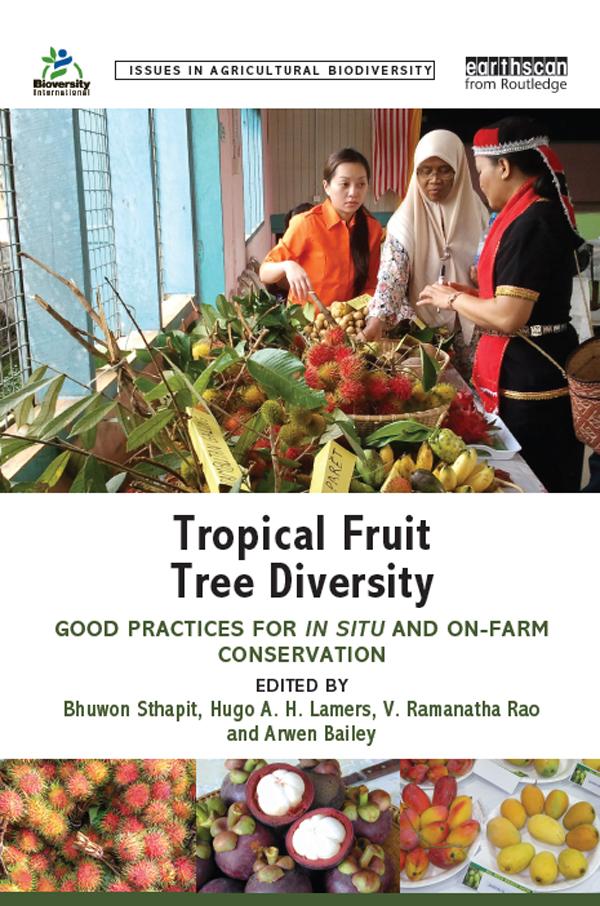
Farmers have developed a range of agricultural practices to sustainably use and maintain a wide diversity of crop species in many parts of the world. This book documents good practices innovated by farmers and collects key reviews on good practices from global experts, not only from the case study countries but also from Brazil, China and other parts of Asia and Latin America.
A good practice for diversity is defined as a system, organization or process that, over time and space, maintains, enhances and creates crop genetic diversity, and ensures its availability to and from farmers and other users. Drawing on experiences from a UNEP-GEF project on "Conservation and Sustainable Use of Wild and Cultivated Tropical Fruit Tree Diversity for Promoting Livelihoods, Food Security and Ecosystem Services", with case studies from India, Indonesia, Malaysia and Thailand, the authors show how methods for identifying good practices are still evolving and challenges in scaling-up remain. They identify key principles effective as a strategy for mainstreaming good practice into development efforts. Few books draw principles and lessons learned from good practices. This book fills this gap by combining good practices from the research project on tropical fruit trees with chapters from external experts to broaden its scope and relevance.
Pay easily by card, Klarna, Apple Pay or Google Pay. Not happy? You always have a 14-day money-back guarantee. Read more in our terms. If you have any questions, email us at hello@memmo.org.
Memmo makes studying easier – wherever you are in the world. We bring your course books and smart study tools together in one place: summaries, quizzes, podcasts and flashcards. Plus Ted, your study buddy who answers anything you wonder. Over 50,000 students already study here – built to help you learn faster and stress less.