
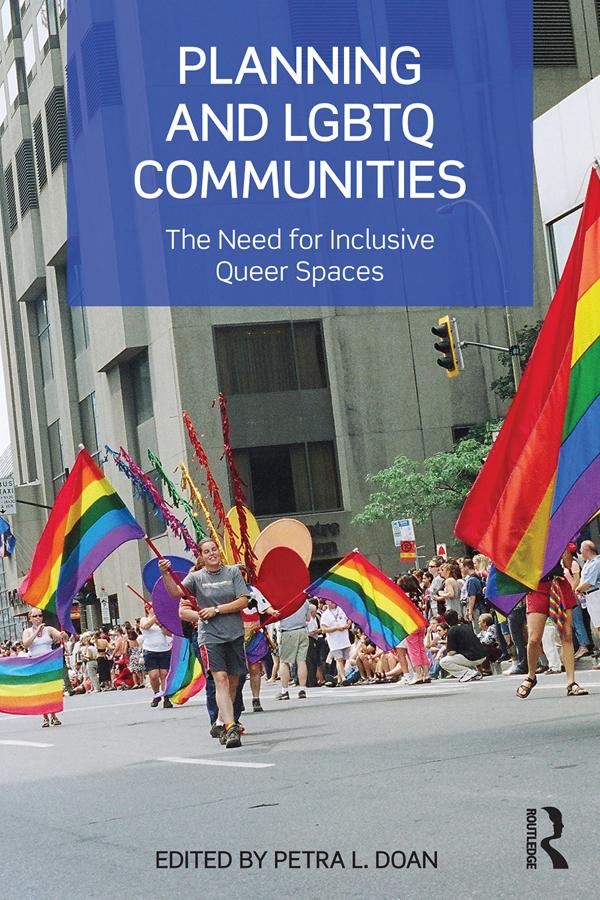
Although the last decade has seen steady progress towards wider acceptance of lesbian, gay, bisexual, transgendered, and queer (LGBTQ) individuals, LGBTQ residential and commercial areas have come under increasing pressure from gentrification and redevelopment initiatives. As a result many of these neighborhoods are losing their special character as safe havens for sexual and gender minorities. Urban planners and municipal officials have sometimes ignored the transformation of these neighborhoods and at other times been complicit in these changes.
Planning and LGBTQ Communities brings together experienced planners, administrators, and researchers in the fields of planning and geography to reflect on the evolution of urban neighborhoods in which LGBTQ populations live, work, and play. The authors examine a variety of LGBTQ residential and commercial areas to highlight policy and planning links to the development of these neighborhoods. Each chapter explores a particular urban context and asks how the field of planning has enabled, facilitated, and/or neglected the specialized and diverse needs of the LGBTQ population.
A central theme of this book is that urban planners need to think "beyond queer space" because LGBTQ populations are more diverse and dispersed than the white gay male populations that created many of the most visible gayborhoods. The authors provide practical guidance for cities and citizens seeking to strengthen neighborhoods that have an explicit LGBTQ focus as well as other areas that are LGBTQ-friendly. They also encourage broader awareness of the needs of this marginalized population and the need to establish more formal linkages between municipal government and a range of LGBTQ groups. Planning and LGBTQ Communities also adds useful material for graduate level courses in planning theory, urban and regional theory, planning for multicultural cities, urban geography, and geographies of gender and sexuality.
Pay easily by card, Klarna, Apple Pay or Google Pay. Not happy? You always have a 14-day money-back guarantee. Read more in our terms. If you have any questions, email us at hello@memmo.org.
Memmo makes studying easier – wherever you are in the world. We bring your course books and smart study tools together in one place: summaries, quizzes, podcasts and flashcards. Plus Ted, your study buddy who answers anything you wonder. Over 75,000 students already study here – built to help you learn faster and stress less.